
While We Slept: Artificial Entanglement
7 in the Series on AI: Understanding the interconnected web of AI entanglement with every social media account, online service, and product.

Jesus says to them, "The kingdom of heaven is like a man who sowed good seed in his field" — but at night, while everyone was sleeping, "his enemy came and sowed weeds among the wheat, and went away" (Matthew 13.24–30). No one knows who did the sowing. The household wakes to find a field that looks just like the field they thought they planted. For weeks, there is no way to tell the difference because darnel appears just like wheat in the blade. Only when it comes time for the crop to bear grain does the difference appear. The servants bring their master two questions. The first asks an accusation in the guise of innocent inquiry: Did you not sow good seed in your field? If so, where did these weeds come from? The second question is far more threatening because it is righteous indignation masquerading as helpfulness: Do you want us to go and gather them?
The master does not argue about the diagnosis. Someone hostile has done this, he says. But he rejects the cure. No; lest in picking up the weeds you root up the wheat with them. Let them grow together until the harvest.
A few verses later in the same chapter, Jesus gives another picture. The kingdom of heaven is like a net that was cast into the sea and caught every kind of fish (Matthew 13.47–50). The net underwater does not sort; the sorting is done on the shore, and the sorters are angels, not fishermen, and the shore is the end of the age.
Two images from one afternoon of teaching, and they teach two sides of one discipline: a field that cannot be cleansed without destroying it, and a net that catches everything and judges nothing until the last day. They are preached to comfort, and rightly: Comfort, comfort my people, says the Lord. But they are also a mirror in this decade, held up to our own individual and corporate accounts. The church is the household that slept. This essay is about what woke us, and about what people of truth may say once awake.
The Web of Daily Bread
Every morning the church prays: give us this day our daily bread. We pray it so often the economics of our breath escapes us: hands. Bread comes by hands, the sower’s and the reaper’s, the miller’s and the baker’s and the carter’s, and to pray for daily bread is to say that my ordinary day is a cloth, and I am held within a weaving I cannot see.
Our Prayer Book has always prayed it so: the General Intercessions trade unashamedly from sinners to those who teach and learn, to those who labor in our safety and our food, to public offices and counselors, to commerce and industry, to the air and elements of weather. All one cloth. Bread remembers the bodies from which it was sheaved and the bodies to which it becomes sustenance.
Pray the morning again, then, in that discipline: say it aloud, and examine your day. I woke and before my feet could hit the floor my hand found the phone to roll out of bed. I saw a message; an AI read it with me and offered my response. I asked the world a question; it answered at my command before my keyboard. I bought bread with a card; a pattern-reader updated its model of me. I looked at my friends’ faces as children while software decided what I would see from face to face to sale, and monetized the choice. Before Breakfast Prayer, half my waking hours were spent attending another liturgy; twelve in all by ten o’clock. Ones I neither chose nor can name the ministers of, in a sanctuary I cannot see. I see not, think not, ponder not the manner of webbed lives lived together to bring to me bread and that I provide bread to.
As poet Zheng Xiaoqiong wrote in his poem entitled Life, “What you don’t know is that my name is hidden by an employee ID; My hands become part of an assembly line, my body signed over.”
Let's now consider the web of names we do know and the interwoven life that moves past the human contribution to build out our lives, hidden by umbrella corporations that do not produce bread but mammon and are interwoven with our lives and investments.
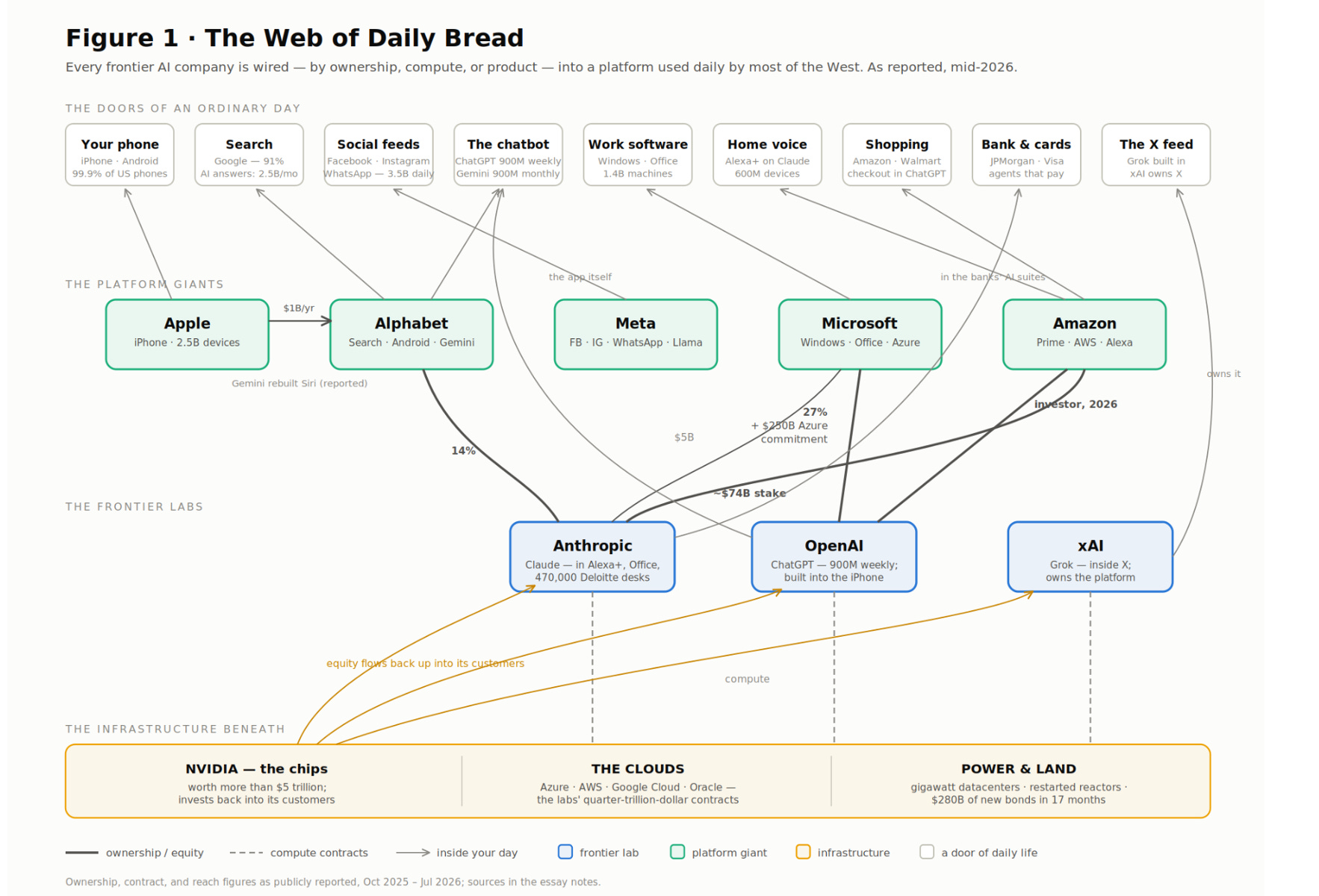
The smartphone in your pocket will be either a Samsung or an iPhone, that is an easy guess, because together Android and iOS are virtually every smartphone in America, and nine out of every ten adults have one.1 Apple designed OpenAI’s ChatGPT into iOS itself, and pays Google a reported billion dollars annually to license their custom model Gemini for Siri.2 Google’browser and search box, nine out of ten searches worldwide, now provides AI-generated answers to two billion users a month before visiting any human website.3 Meta enabled its Assistant across Facebook, Instagram, and WhatsApp, three apps opened by more than three and a half billion people every day, and netted a billion monthly users without trying at all.4 Microsoft’s Copilot lives on every Windows machine in the world, billions, and the program desktop workers in the West file their memos and their sermons on it, while Microsoft owns twenty-seven percent of OpenAI whose ChatGPT is queried weekly by nine hundred million people and has signed Azure to its cloud for quarter trillion dollars.5 Amazon built Anthropic’s Claude into six hundred million Alexa devices given free with two hundred million Prime memberships in America alone; Amazon leads $17 billion invested into Anthropic, and is an investor in OpenAI too.6 The social network X is hardly simply partnered with an AI company: it is owned by one.7 Nvidia made $90 billion last year helping them all; every lab above owns its chips, and will invest $40 billion more into OpenAI, Anthropic, xAI, and other datacenter landlords over the coming years: its portfolio companies are its customers in a market becoming embraced.8
That half our waking hours are shared with a cloud is already obvious. But it is not because of our phones. The above is essential in understanding the complicated web of AI production. Bank of America powers Erica on two billion devices, and Morgan Stanley has put eleven billion dollars into AI in part by putting a set of language models on every advisor’s desk. JPMorgan put its own complete suite on a quarter million desks last year. Visa and Mastercard have built the entire card network open to AI agents that can spend your money for you. Walmart serves two hundred seventy million customers weekly and now lets you buy through ChatGPT. Your doctor may contact you via a model working behind the scenes at their EHR.9 It is extraordinary how quickly hospitals, airlines, banks and drugstores have all come to share something essential with engineers in Mountain View. There is no routine of waking, asking, writing, shopping, banking or healing through which one or a couple of these companies, erhaps ten in all, is not already inside your head, trading on your choices. They are investors and suppliers to one another, plaintiffs and co-defendants too.
‘Principalities and powers’ is the tradition’s word for them. Principalities and powers; they have existed longer than digital language models, because they are preprogrammed into sin. The principalities and powers of this world are not spirits hovering over society. They are the spirits that organize it: bureaucratic, earthly, greedy to be God. The powers do not need your prayer if they can have your day and help you with your bread: and they have it, from the buzzing cell to the glowing screen.
Christendom has seen companies join themselves together before. Companies that ruled the waves, that set trading conditions for a quarter of humanity. Christendom learned to read them: creaturely, fallen, missionary, penalized by their end.
All economics follow from that closer attention.
A full fifteen percent of the American information technology workforce builds these models. Each of their five trillion dollars of collective market cap funds another fifty billion dollars’ workforce outside it: researchers, servers, lobbyists, educators. The chart does not capture the additional fifteen hundred and thirty thousand US Patents these companies pooled last year defending what cannot be defended — their positions against each other. Or the fifty thousand specialists in workplace satisfaction Google alone calls employees, working to keep their half of the half of humanity inside Apple happy. Or that from OpenAI’s beginning Elon Musk has accessed its board by special corporate flight on SpaceX jets.12 The family of giants spins together.
If ten of these companies have their fingers on the world, so do thier estimated sixty thousand lobbyists marching our legislators towards what ought not be: under Google they have been every year since Alphabet was born in 2015. Congress has banned itself from meaningful oversight of AI in public by voting a permanent filibuster against setting up the official AI Agency our president created it.13 Divided as our politics are there is one vote on which both sides can agree: build the monsters, and build them now. This is the speed chips beg of us.
For public theologians, we must recognize that only after the tradition should the economists speak. But it is not the first time we as humans have bumbled ourselves into such a web of deceit and greed.
Scholars like Shoshana Zuboff have studied what surveillance capitalism exploits: free human experience captured as behavioral data for markets in AI predictions. An economy Shoshana Zuboff likens to the sociologist’s one-way mirror: everything about us knows us, and we know next to nothing about it.10 That phrase summarizes their central agreed-upon truth. But so does the tradition. It is new technology in old hearts. Surveill means to watch. Since God the eyes that are not God’s have watched us, want to, and aspire with total seeing to be our maker.11 Of course humans have longed to be gods and demigods over others. Today, four of them, Alphabet, Amazon, Meta, Microsoft, will invest toward seven hundred billion dollars training these models in 2023.11 More than a fiftieth of annual US GDP is being bet, in one year, on a single piece of physics. Figure 1 traces four wires from four companies into our daily breath and bread. Hold it against your Scriptures: they are one cord.
The Field Held in Common
Every Sunday our ushers pass the plate, and the people put into it what the week has earned them, and the celebrant lifts it with the ancient words from David’s prayer over the temple treasury: all things come of thee, O Lord, and of thine own have we given thee (1 Chronicles 29.14). Then set the plate on the altar, because we honor hard work, provision of our first fruits, and that these things might be used for God’s good work for God’s people. The plate contains the whole economy in miniature for Christians. Wages are in it, and pensions, and dividends; debts too, and severance, and the folded bill from somebody’s fixed income. And, we must recognize honestly that the church has never collected clean money because there has never been any: David knew whose gold he was blessing. As the plate is to the parish, the portfolio is to a people, and every dollar invested is a theological statement about what we believe the world should become.12 The notion that somehow money is clean is a lie sold by the Powers and Principalities, which we have agreed to use. It is why it must be blessed, not for its illicitness, but because we need to show we are going to launder it for Jesus and for the good of humanity.
Let us be clear too, behind the plate, and beneath many of our roofs, stands an endowment; behind that the diocesan trust and the pension fund and the teacher’s 403(b) and the young curate’s target-date account compounding quietly in the dark. Quietly, and by instruction: the genius of the modern portfolio is that it grows up while you sleep. Consider this: six of ten workers on America’s largest retirement platform invest in a single target-date fund of various types, entered, allocated, and rebalanced automatically until the harvest date printed on the fund’s label, and two of every three new retirement dollars now flow into such funds.13 We built ourselves a field that tends itself so we would not have to watch it grow. While everyone was sleeping. “While you slept” is the clause we always read as the parable’s scenery. It turns out to be its engine, and ours.
Please then wake and walk the field. It has three depths, and the deeper you go, the less anyone thought about what we chose to grow there.
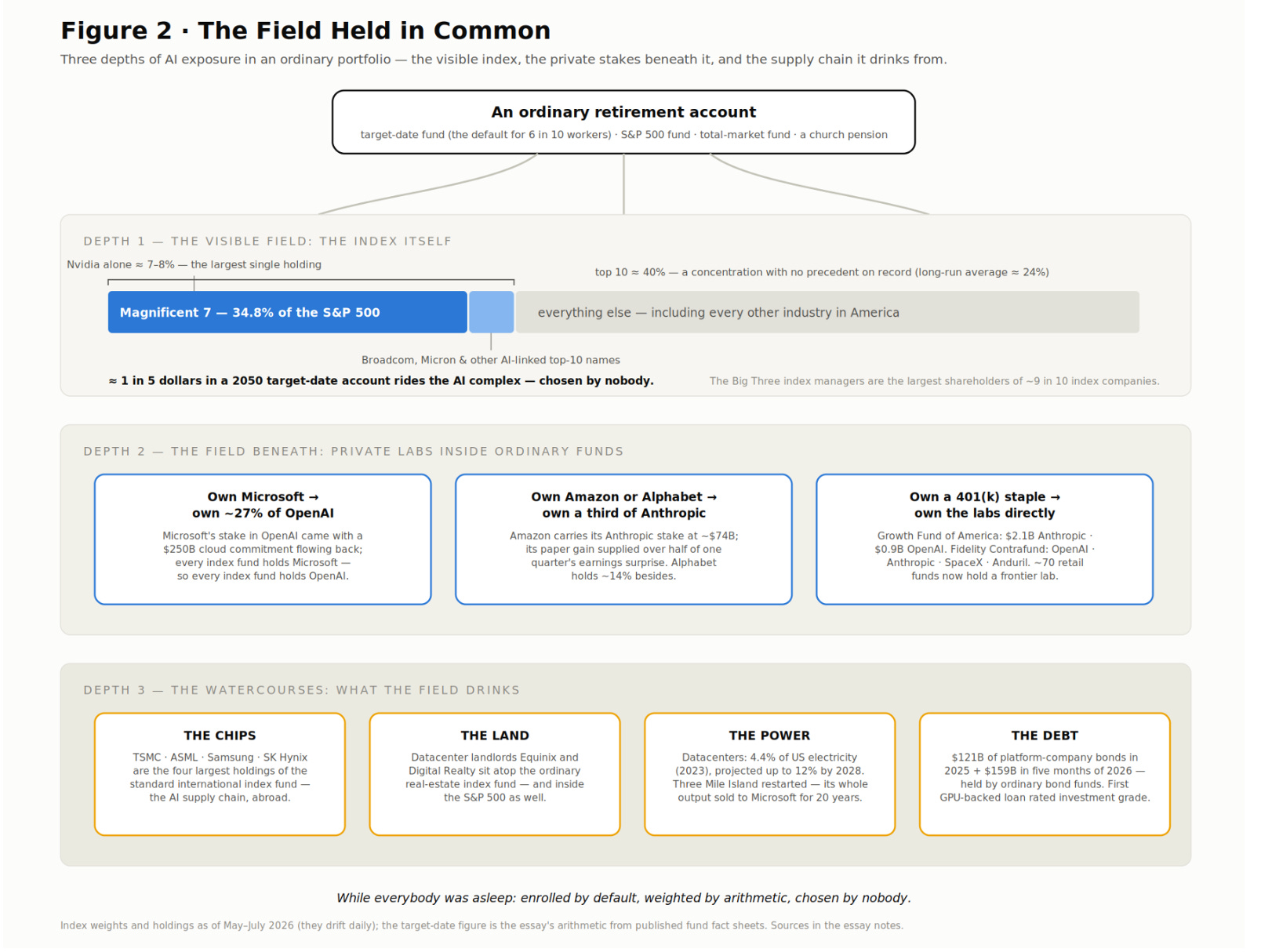
The first depth is what we see: the visible field. Its rows have grown astonishingly few. Twenty years ago the ten largest companies made up an eighth of the S&P 500. Today Nvidia, Microsoft, Apple, Alphabet, Amazon, Meta, and Tesla now account for about a third, and the ten largest holdings approach two-fifths of the index, a concentration unprecedented of the market’s entire history.14 Nvidia, the foundry that arms every lab, is the single largest holding of the great index funds, and the managers of those funds, Vanguard, BlackRock, and State Street, hold about a fifth of Nvidia itself and are among the largest shareholders of eight in ten companies in the index.15
Vanguard’s flagship became this June the first trillion-dollar exchange-traded fund in history; nearly two-fifths of it sits in names linked to AI.16 Plug the worker auto-enrolled at the median target-date fund into that arithmetic and the answer comes out like this: about a fifth of her retirement dollars now ride on the fortunes of the AI complex, Nvidia and Meta and Microsoft and Alphabet, plus the Taiwanese and Dutch and Korean toolmakers in the fund’s international sleeve, and she chose none of it.17 Nor has the church chosen elsewhere: the endowments of the Episcopal Church and other churches are paying our own clergy allocations against a world index whose ten largest positions cannot help but be AI-linked at one level or another.18 This is not a portfolio with exposure to AI. This is exposure to AI with a portfolio attached. Not because of AI, but because of the interweb of relationships shown above, tied into every part of our waking lives. So let's go one depth deeper.
The second depth is the field beneath the field; look there and you will find the private seed companies growing. Labs whose names never show on the statement. Whoever owns Microsoft owns, at one remove, 27% of OpenAI. Whoever owns Amazon owns an equity stake in Anthropic lately valued at $74 billion, a position that alone generated more than half of that company’s earnings surprise last quarter. Whoever owns Alphabet owns a seventh of Anthropic besides.19 The ordinary index funds have gone spelunking too: the Growth Fund of America, a mainstay of the American 401(k), holds $2 billion of private Anthropic and $886 million of OpenAI; Fidelity’s Contrafund lists OpenAI, Anthropic, SpaceX, and an investment in the weapons contractor Anduril; as of this writing some seventy retail funds now hold a position in one lab or the other.20 The seed companies are already in the barn, friends. The barn is where the pensions are kept.
Beneath the barn is the third depth: the watercourses. Everything the field drinks. The international index fund? Four of its ten largest holdings are the chipmakers and semiconductor toolmakers of the AI supply chain. The real estate fund? Its leaderboard is populated by datacenter landlords.21 The utilities? Last year American datacenters consumed between four and five percent of national electricity use, and that share is projected to nearly double by 2028; Three Mile Island is restarting up, its entire output sold to Microsoft for the next two decades, and its owner sits in every index fund you can buy.22 The bond fund? The refuge of the drabbest among us? Big tech sold $121 billion of bonds last year and another $159 billion in the first five months of this one; which is to say the ordinary bond fund now finances the loom. Last March the first loan collateralized by GPU servers was rated investment grade.23 Strip the AI stocks out of the market over the last two years, and most of the return disappears with them. By some estimates, building these machines has contributed the majority of recent US GDP growth itself.24 I am not an economist, yet it did not take long to understand the above web of interlocking investments.
At this point the parable must leave its comfort zone. Jesus tells the story in Matthew and the adversary comes by night; he’s a person you could summon if you wished. In our field there was no person. The sowing was done by arithmetic, by the cap-weighted index that automatically buys more of whatever firm is growing largest; by the auto-enrollment form; by the default option. Like many human things we planted without counting the cost and understanding the full effect of the seed sown. That is not an excuse for us. It is a diagnosis. We have created, not unlike other parts of our lives, an anonymity to which we must now serve. The work of what Scripture calls powers: structures that sin on our behalf without any single villain required, and then present us the proceeds as if they were our own prudence.
I am not denying individual manipulation, individual greed, or opportunistic wealth sowing and reaping. Yet your anonymity is important when we consider that, when we speak about the web of relational investments, we are all part of it, even though we do not take an active role, and it happens with very little of our knowing.
And so the servants ask. We must ask the question again, which now has our names in it. Do you want us to go and gather them? To uproot the AI complex from the common field, sell every last share today, everywhere that it touches? Shall we break the powers, yes. But it would also break the teacher’s pension. It would break the widow’s target-date fund. It would break the endowment that underwrites the pantry van, that fills the SNAP gap, or meets the needs of those in need of healthcare. To gather the weeds would be to uproot the wheat too. Which is why the master says, “No”. Because he loves the mouths the bread feeds, that are dependent upon the wheat. Listen to your powers, and you will hear them say, “The field is fine; go back to sleep.” But notice what the master doesn’t say. He doesn’t say the weeds are wheat. The master does not say the field is fine or healthy. And he doesn’t say, "Go back to sleep."
The Sword
Two verses earlier, Jesus walks among those who came for him with swords and clubs. One of those who stood around Jesus took up the only policy his fear could devise. He drew his sword and smote the servant of the priests, cutting off his ear. Put your sword back into its place, Jesus said: for all who take the sword will perish by the sword (Matthew 26.51–52). The Christian tradition has never heard this word only about gardens. It heard the full trajectory of the kingdom’s working metal when Jesus spoke it, the trajectory Isaiah heard three centuries before: they shall beat their swords into plowshares, and their spears into pruning hooks (Isaiah 2.4) takes root. Scripture bears witness that the forge turns the other way as well. After that prophecy, Joel sees his people summoned by other nations in panic: "beat your plowshares into swords, and your pruning hooks into spears” (Joel 3.10). Every age funnels its metal down one chute or the other; the prophets don’t ask if a people has iron, they ask which way it is flowing and how is it to be used in this moment.
Our country’s spears flow toward Joel’s image. If we say this plainly, let us also say whose forges do the work: the same corporations that tend the field our household puts its bread ticket in every week grow alongside income, savings, and pensions.
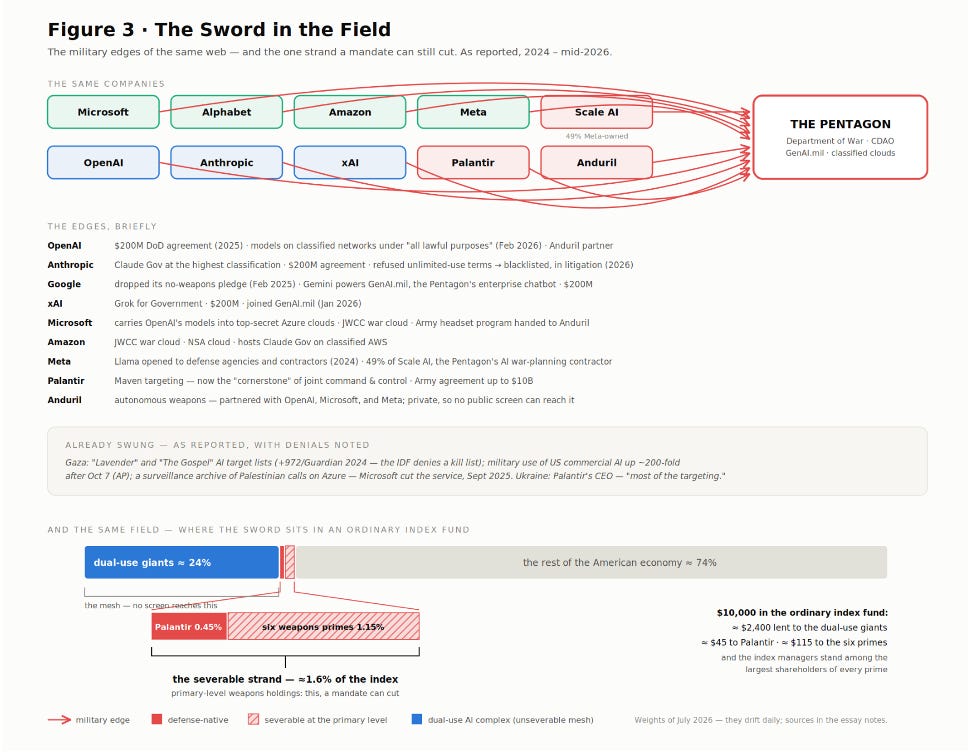
Consider this: OpenAI removed the sentence prohibiting “military and warfare” uses from its publicly available usage policy in January of 2024; by December, OpenAI partnered with Anduril, the autonomous weapons company, to point its models at drones.25 Within 28 days in summer 2025, all major American frontier labs OpenAI, Anthropic, Google, xAI signed Pentagon contracts worth up to $200 million each to help prototype frontier AI applications for “national security.”26 Google pledged in 2018 not to design AI for weapons or surveillance; the company quietly deleted that pledge from its AI principles in February 2025 and launched its Pentagon cloud partnership later that December, around which millions in uniform would flow, with Gemini, the same model that powers Search, running the DoD’s new enterprise chatbot, and Grok arriving weeks later.27 Microsoft’s Cloud already powers the secret networks where OpenAI’s models have run for the Department; Microsoft’s “brain-controlled computer” headset program for soldiers transferred to Anduril atop Microsoft Azure.28 Meta released Llama to defense contractors and agencies and purchased a stake in Scale AI, which the Pentagon selected as its contractor to build AI war plans.29 Palantir’s Maven system, built to find enemies’ faces in its ocean of surveillance, added half a billion dollars to its Pentagon contract, becoming what the Deputy Secretary recently described as the “cornerstone of joint command and control” and earning the Army’s business a new contract worth up to ten billion dollars.30 In January 2026, the Pentagon released its new strategy on military AI, ordering each department's AI contract to include terms that permit “any lawful use” of the technology being bought, the significance of which we will unpack below.31
The reality is that we may debate military spending and what we need to spend on. That is not the point of the essay. The point of the essay is to reveal that not only is the web of investment complicated enough to name that a book purchased on Amazon with your Bank of America card already is part of the AI web of relationships and that it is wired into the military-industrial complex. Moreover, even clean energy investment is connected.
Draw the wires out far enough and the old binaries of dirty and clean energy break down. All energy eventually powers two sockets: the AI data center and the defense establishment. Chevron just signed an exclusive 2.7-gigawatt contract to supply electricity to Microsoft’s sprawling data center complex in West Texas and is publicly “chasing after more deals like it,” while natural gas producers tout themselves as the energy-boom’s essential fuel, “the energy trade of the century”; oil majors cash in both ways, using AI to wring more oil from wells while selling electricity that trains it. Renewable energy doesn’t get a pass: Google, Amazon, Meta and Microsoft have all signed contracts to purchase nuclear power, reviving old reactors, committing to small modular reactors, signing decade-long supply agreements, to feed AI models as well. This is increasingly Gigawatts extracted from Permian Basin gas fields and freshly unlocked nuclear reactors are now training models for the security state. Petroleum and electrons, wind turbines and nuclear reactors, contenders in partisan disputes over climate, mesh together here in one energy-defense-industrial complex where energy companies monetize AI, AI powers the security state, and the security state secures demand for both. Oil and Gas or clean energy? Both power our U.S. military-industrial complex, and are also tied to AI now.
I hope you understand that while you slept, the sword has been swung already. Israeli intelligence agents have described to reporters AI systems named “The Gospel” and “Lavender” that provided strike lists in Gaza at a stupefying rate: algorithms analyzed and scored tens of thousands of human beings for death based on patterns, with targets ultimately receiving “about twenty seconds of review” by an officer. “I had zero added value as a human, apart from being a stamp of approval.” One military official involved denies that such a kill list exists. All the companies whose clouds and models powered that war insist they found no evidence their technology was involved in the targeting decisions. The Associated Press found that the Pentagon’s usage of these American commercial AIs increased by nearly 200x after October 7, 2023.32 No one needs to decide these contested facts to understand the truth that is not up for dispute: we have entered the era where an algorithm proposes whom the sword will fall upon.
The companies, swords, phones, and science flowing through Figures 1 and 2 now render a capability to recommend death on an industrial scale, a capability whose judgments, we are told, will continue to improve. In Ukraine, Palantir’s CEO has boasted that his firm’s software powers “the vast majority” of targeting.33 So, if you support Ukraine against Russia, you are supporting this type of usage. Again, the theological stake need not wait on the fog of war: whether Israel, Ukraine, future partners, or agencies we will never hear about from these companies, a software system that ranks humans for death has been entrusted a responsibility our tradition only ascribes to Christ the Judge of all the earth. And enrolled into that judgment is the image of God.
Put it away now, because this is an essay about the field. All six of those classic weapons stocks, Lockheed Martin, RTX, Northrop Grumman, General Dynamics, Boeing, L3Harris, are represented in roughly equal proportion in a typical S&P 500 index fund. Palantir is already over twice Lockheed Martin. Those five titans of dual-use tech whose clouds, chips, and models will bear this new military wonder carry roughly a quarter of the index all on their own. Buy $10,000 of the ordinary fund, and you lend about $115 to the primes, $45 to Palantir, and $2,400 to the companies building the web around you; and the money managers responsible for stewing that portion of your household’s savings are among the largest shareholders of every prime contractor in the land.34
This is the shape your mission must now reckon with honestly. The sword cannot be merely a sector we decline to touch. The sword is steel folded through the field’s entirety, proportionately richest, in fact, not in the divisions labeled defense, but those labeled technology or energy. Figure 3 overlays that information, extracting only one thread remaining.
The Honest Word
Two lies now stand ready for the church’s mouth, and each has a constituency, and each would be easier than the truth; they typically do battle via social media and at our general gatherings. Both misconstrue a world that does not exist as they describe it.
The first lie is purity. It says: gather the weeds. Sell every share, screen every fund, publish the press release, walk out of the field clean. But the field, Jesus says, is the world, and Paul told the Corinthians the same thing about their economy that the master told the servants about the field: if you want to dissociate entirely from the greedy and the robbers, you would then need to go out of the world (1 Corinthians 5.10). The weapons primes are one percent of the index; the dual-use giants are a quarter of it; and the newest sword-makers are private companies no public divestment can touch, even as the regulators open ordinary retirement accounts to private markets, so that the unreachable field grows.35 A church that announces its own successful extraction has not left the field. It has only stopped telling the truth about where its feet are standing. The pension check still clears, the pledges are deposited, and the endowment fund pays out. The funds people and the church depend upon still compound. The purity is paper purity, and the world can smell it.
The second lie is inevitability. It says: because extraction is impossible, refusal is meaningless; the sword will be forged with us or without us, so it may as well pay our pensions. This is the powers’ favorite sermon; Zuboff heard it years ago and named it the aura of inevitability, the doctrine the system preaches about itself.36 But the powers are creatures made of human beings, CEOs and board members, and this very year has produced witnesses against their doctrine.
One frontier laboratory refused to strike from its military contracts the clauses barring mass surveillance and autonomous weapons, and for keeping its red lines was designated a “supply chain risk,” a mark never before laid on an American company; a federal judge called the designation retaliation, and the refusal stands.37 One platform company, confronted with reporting that its cloud held a surveillance archive of an occupied people’s telephone calls, cut the service, “we do not provide technology to facilitate mass surveillance of civilians,” and later conceded the reporting was in elements true.38 These are not canonizations; the refusals were partial, costly, contested, and that is precisely their value. They prove what inevitability denies: that inside the field, this side of the harvest, a hand can still decline, a line can still be held, a plowshare can still be hammered out.
Between the two lies the honest word. It is smaller than the first lie and braver than the second, and it has three clauses. It is the one public theology needs to focus upon, and our actions need be attentive to.
The first clause: where our hand actually holds a strand, we cut it. At the primary level, the funds we ourselves select, the mandates we ourselves write, the securities we directly own and command, no investment in the manufacture of weapons. Here the church is not being asked to invent anything; it is being asked to mean what it has already said. Our Executive Council keeps a No-Buy List that bars the five largest American defense contractors by name, and any major contractor drawing more than half its revenue from military work; and the 81st General Convention resolved, in 2024, that the church’s exclusions must reach the makers of indiscriminate weapons , naming lethal autonomous weapons among them.39 The screened instruments exist; even the largest index houses sell broad funds that exclude the weapons manufacturers.40 The first clause is implementable this fiscal year, kept current as the sword-makers change shape, and kept without the pretense that it cleanses us. It does not cleanse us. The servants were forbidden the field’s purging; they were never forbidden their own obedience. What I am saying is that the strength lies not in any resolution or one action but in the action of each one of us.
And, because we believe in the importance of individual action freely taken, we need to publish the list and invite, not mandate, parishioners to take action. This is our Episcopal way.
The second clause: where the mesh holds us, we say so. Naaman the Syrian, healed in the Jordan, stood before the prophet and told the truth about the house he was going home to: when my master goes into the house of Rimmon to worship there, leaning on my arm, and I bow down in the house of Rimmon, may the LORD pardon your servant in this one thing. And Elisha did not excommunicate him, and did not excuse him. He said: go in peace (2 Kings 5.18–19). There is a whole ethics of entanglement in those three words, neither license nor exile, but grace for the honest. The church’s version of Naaman’s sentence should be an annual one, published, specific: here is where the index holds us, the dual-use quarter of every broad fund, the private laboratories our screens cannot reach; here is what we voted with our shares, what we pressed the managers for, what we failed at. Even the divisions within our own house belong in the saying: the church’s mission society keeps the no-buy list, while the fund that supports our mission has chosen engagement over exclusion, a live and unfinished argument among the faithful, which honesty must name rather than paper over.41 May the Lord pardon his servants. In an economy built on the one-way mirror, let the church be the one institution whose windows are glass both ways.
The third clause: we keep the watch. The enemy sowed while we slept, and the sowing has not stopped. The church’s oldest discipline against the dark is not the sword Peter reached for; it is the vigil. Keep watch, dear Lord, with those who work, or watch, or weep this night. Wakefulness is a liturgical act before it becomes a policy, and then it must become one: the annual review conducted like an examination of conscience; the questions asked aloud in vestry and convention; the proxies voted, for the index managers hold, in the end, our savings, and the church’s small voice sits inside a very large one; the advocacy sustained until human judgment over life and death is written back into law and contract; the watch handed on, treasurer to treasurer, convention to convention, as the office is handed on at nightfall.
I will tell you when this stopped being an argument for me and became a practice. It was when I realized our and my own complicitness, even though I have tried to be a good steward. I confess what I could not sever. I give thanks for what the returns will do, the curate’s stipend, the pantry’s van, the camp scholarships. And then I said the sentence the church has always said over compromised gifts: all things come of thee, O Lord, and of thine own have we given thee.
And the bread, this is the whole of it, the bread made from this economy’s wheat, grown in the very rows where the tares stand; God does not refuse. God takes it, blesses it, breaks it, and gives it back as the Body given for the world. Gift is the one motion the net cannot predict, because gift moves outward and does not feed on itself. The field does not have to be pure to become the matter of the kingdom. It has to be offered.
I have often said, “We are money laundering for the Lord Jesus.” Indeed, that is a funny way of understanding both our human sin and our good work in one breath.
So the images return, transformed, as they must. The net is still in the water and we are still in the net, but the net that holds at the last is not the one the companies wove; it is the mercy that sorts on the shore, and the sorting is not our work, and that is not our despair but our peace. The field is still mixed, and will be until the end, as it has always been, but the harvest has a Lord, who has told the servants their part: the honest word, the severed strand, the vigil, the table. Let both grow together until the harvest. Until then: keep watch, dear Lord, with those who work, or watch, or weep this night.
Coda: To Vestries, Trustees, and Investment Committees
What the essay says in images, policy must say in clauses. Three are enough to begin. First, adopt the primary-level exclusion: no direct holdings, in any fund you select or mandate you write, in the manufacturers of weapons, with the Executive Council’s No-Buy List and General Convention’s resolution on indiscriminate and autonomous weapons as your floor, and the diocesan Faith and Code screening checklist as your working instrument.42 Second, adopt Naaman’s audit: one page, once a year, published to the parish or the convention, where the mesh holds you, what you voted, what you pressed for, what you could not reach, read aloud at the annual meeting and prayed over at the confession and offertory. Third, keep the watch: name the officer who owns the review, set it in the calendar beside the audit and the ember days, and hand it on. None of this will extract you from the field; it is not meant to. It is meant to make you the kind of household that is awake in it, praying, ministering, giving, serving, until the Lord of the harvest comes.
Notes
1. Pew Research Center, Mobile Fact Sheet (Nov. 2024): 91% of U.S. adults own a smartphone; StatCounter, U.S. mobile OS share (June 2026): iOS 58.4%, Android 41.6%.
2. Apple integrated ChatGPT into Apple Intelligence beginning Dec. 2024 (iOS 18.2); on the reported ~$1B-per-year Apple–Google agreement for a custom Gemini model powering Siri: CNBC (Jan. 12, 2026) — reported, not confirmed by either company; Apple, WWDC announcements (June 8, 2026).
3. StatCounter, worldwide search share (June 2026): Google 91.3%; Google I/O keynote (May 19, 2026): AI Overviews above 2.5 billion monthly users.
4. CNBC (May 28, 2025): Meta AI reaches 1 billion monthly active users; Meta, Q1 2026 results (Apr. 29, 2026): 3.56 billion daily active people across its apps.
5. Microsoft statements (2025): ~1.4 billion monthly active Windows devices; Microsoft–OpenAI restructured partnership (Oct. 28, 2025): Microsoft holds ~27% of OpenAI Group PBC and OpenAI committed to ~$250B of incremental Azure purchases (Microsoft; CNBC; Bloomberg, Oct. 28, 2025); OpenAI (Mar. 31, 2026): ChatGPT above 900 million weekly active users.
6. CNBC (Feb. 28, 2025) and Amazon announcements: Alexa+’s most powerful features powered by Anthropic’s Claude; rollout to all U.S. users (Feb. 2026) across 600M+ Alexa devices, included with Prime (~200M U.S. memberships, CIRP 2026); Amazon’s Anthropic position carried at ~$74.2B (Amazon Form 10-Q, Apr. 2026; Fortune, June 4, 2026); Alphabet holds ~14% of Anthropic (court filings, 2025); Amazon among the anchors of OpenAI’s $122B round (OpenAI, Mar. 31, 2026).
7. xAI acquired X in an all-stock transaction valuing X at $33B (CNBC, Mar. 28, 2025).
8. Nvidia market capitalization above $5 trillion (Forbes, May 13, 2026); Nvidia investments and commitments: up to $100B alongside a 10GW OpenAI deployment (Nvidia, Sept. 22, 2025 — a letter of intent, later restructured toward equity participation in OpenAI’s Mar. 2026 round), up to $10B in Anthropic (Nov. 18, 2025), xAI Series E (Jan. 6, 2026), CoreWeave (Jan. 2026), Intel $5B (Dec. 2025).
9. JPMorgan LLM Suite (CNBC, Aug. 9, 2024; JPMorganChase, 2025–26); Morgan Stanley–OpenAI assistant, ~98% advisor-team adoption (CNBC, Sept. 18, 2023; OpenAI case study, 2024); Bank of America, Erica at 3 billion interactions (Aug. 2025); Visa Intelligent Commerce (Apr. 30, 2025) and Mastercard Agent Pay (Apr. 29, 2025); Walmart–OpenAI Instant Checkout (Oct. 14, 2025); Epic–Microsoft Azure OpenAI in clinician workflows, including patient-message drafting (Epic, 2023–25).
10. Shoshana Zuboff, The Age of Surveillance Capitalism (PublicAffairs, 2019).
11. CNBC (Feb. 6, 2026): combined 2026 capital expenditure of Alphabet, Amazon, Meta, and Microsoft approaching $700B, against U.S. GDP of roughly $30T (author’s ratio).
12. C. Andrew Doyle, Faith and Code: White Paper for the Task Force on AI (Episcopal Diocese of Texas, Apr. 2026), Part Two.
13. Vanguard, How America Saves 2026 (June 2026): 61% of participants hold a single target-date fund; nearly two of three contribution dollars flow to TDFs; 61% of plans (79% of large plans) auto-enroll; target-date assets $5.2T (Sway Research via NAPA, Feb. 2026); U.S. retirement assets $49.1T at year-end 2025, 34% of household financial assets (Investment Company Institute, Q1 2026).
14. Magnificent 7 at 34.8% of the S&P 500 (May 2026) vs. 12.5% in 2016 (Motley Fool Research, May 13, 2026; 33–36% by daily weightings, July 2026); top-10 concentration near 40% vs. a long-run average of ~24% and a prior record of 28% in 1970 (Pensions & Investments, Jan. 8, 2026; Forbes, June 2026).
15. Nvidia at ~7.4–8% of the index (Slickcharts/StockAnalysis, July 2026); Vanguard 9.3%, BlackRock 7.5%, State Street 4.1% of Nvidia (13F aggregation, Mar. 31, 2026); the Big Three as collectively largest shareholder in ~88% of S&P 500 companies (Bebchuk & Hirst, restated 2026), on combined assets above $30T (BlackRock $13.9T, SEC filing Q1 2026; Vanguard ~$11.6T; State Street ~$5.7T).
16. Bloomberg (June 3, 2026): Vanguard’s VOO becomes the first ETF to reach $1T; top ten holdings 39.2% of assets (July 2026).
17. Author’s arithmetic from the Vanguard Target Retirement 2050 fact sheet (Mar. 31, 2026: 52.6% U.S. total market, 36.8% international) and VTI/VXUS weightings (July 2026): ~16% in the Magnificent 7 plus ~3.5% in TSMC, ASML, Samsung, and SK Hynix.
18. Church Pension Fund, investment profile (Mar. 31, 2026): benchmark 62% MSCI ACWI / 38% Bloomberg U.S. Aggregate; iShares MSCI ACWI fact sheet (Mar. 31, 2026): top ten holdings, 22.95% of the index — Nvidia, Apple, Microsoft, Amazon, Alphabet, Broadcom, TSMC, Meta, Tesla.
19. Microsoft Form 10-Q (quarter ended Mar. 31, 2026); Amazon Q1 2026 results: $16.8B pre-tax gain on its Anthropic holding; Bloomberg (Apr. 24, 2026): Alphabet’s ~14% stake and up to $40B of additional commitment.
20. Q1 2026 fund filings: Growth Fund of America held ~$2.06B of Anthropic and ~$917M of OpenAI; Fidelity Contrafund schedule of investments (June 29, 2026): OpenAI, Anthropic, SpaceX (6.8% of the fund), Anduril; ~72 funds holding Anthropic and ~66 holding OpenAI; OpenAI’s Mar. 2026 round also included the University of California’s investment office and the sovereign funds MGX and Temasek (OpenAI, Mar. 31, 2026).
21. Vanguard VXUS top holdings (July 2026): TSMC 4.0%, Samsung 2.2%, SK Hynix 1.9%, ASML 1.4%; Vanguard VNQ top holdings include Equinix, American Tower, and Digital Realty (July 2026).
22. U.S. Department of Energy / Lawrence Berkeley National Laboratory (Dec. 2024): datacenters at 4.4% of U.S. electricity in 2023, projected 6.7–12% by 2028; EIA (Jan. 13, 2026); Constellation–Microsoft 20-year power purchase agreement for the restarted Three Mile Island Unit 1 (CNBC, Sept. 20, 2024; World Nuclear News, 2026).
23. LPL Financial (May 28, 2026): hyperscaler bond issuance of $121B in 2025 and $159B in Jan.–May 2026; technology now ~10% of the U.S. investment-grade corporate index; Bloomberg (Oct. 30, 2025): Meta’s $30B bond drew ~$125B of orders; Moody’s rated CoreWeave’s $8.5B GPU-backed facility investment grade (A3) on Mar. 31, 2026.
24. S&P Dow Jones Indices via Statista (Jan. 6, 2026): Nvidia, Alphabet, Microsoft, and Broadcom supplied ~44% of the S&P 500’s 2025 return; 24/7 Wall St. (May 25, 2026): excluding AI names, the 22-month return falls from ~42% to ~16%; J.P. Morgan Asset Management (Sept. 2025) and Pantheon Macroeconomics via Fortune (Feb. 23, 2026) on AI capital spending and GDP growth — analyst-derived and contested (cf. CNBC, Jan. 26, 2026); IT capex at a record 35%+ of S&P 500 capex (May 2026).
25. The Intercept (Jan. 12, 2024); CNBC (Jan. 16, 2024); OpenAI–Anduril partnership (joint announcement, Dec. 4, 2024).
26. DoD Chief Digital and AI Office awards: OpenAI (June 16, 2025); Anthropic, Google, and xAI (July 14, 2025) — ceilings of $200M each (CNBC, July 14, 2025; company statements).
27. Washington Post and CNBC (Feb. 4, 2025) on Google’s removal of its weapons and surveillance pledge; Defense News and DefenseScoop (Dec. 9, 2025) on GenAI.mil powered by Gemini; NPR (Jan. 13, 2026) on Grok’s addition.
28. DefenseScoop (May 7, 2024; Jan. 16, 2025) on GPT-4 and GPT-4o in Azure Government Top Secret; Nextgov (Apr. 2025) on Azure OpenAI at Impact Level 6; Microsoft–Anduril IVAS announcement (Feb. 11, 2025).
29. Meta (Nov. 4, 2024): Llama for U.S. national security agencies and contractors; CNBC (June 12, 2025): $14.3B for 49% of Scale AI; Defense Innovation Unit (Mar. 5, 2025): Thunderforge.
30. DefenseScoop (May 23, 2025; Apr. 3, 2026): Maven Smart System from a $480M award to a ~$1.3B ceiling to program of record and “cornerstone” of joint command and control; Army–Palantir enterprise agreement up to $10B (July 31, 2025); Palantir FY2025 results (SEC filing, Feb. 2026): U.S. government revenue of $1.855B.
31. Department of War, Artificial Intelligence Strategy (Jan. 12, 2026); DefenseScoop (Jan. 13, 2026).
32. +972 Magazine/Local Call, “A Mass Assassination Factory” (Nov. 30, 2023) and “Lavender” (Apr. 3, 2024, with the Guardian) — investigative reporting based on anonymous Israeli intelligence sources; the IDF denies that a “kill list” exists and states that analysts independently review targets under international law; Associated Press (Feb. 18, 2025) on the ~200-fold rise in Israeli military use of Microsoft and OpenAI commercial AI after Oct. 7, 2023; Microsoft statement (May 15, 2025) confirming Azure and AI services to Israel’s Ministry of Defense and reporting no evidence to date that its technologies were used to target or harm; Guardian/+972 (Aug. 6, 2025) on the Unit 8200 Azure archive — reported; OpenAI states it has no partnership with the IDF.
33. Alex Karp, Palantir CEO (Euronews, Feb. 2, 2023); Time (Feb. 2024).
34. S&P 500 weightings (Slickcharts, July 13, 2026 — weights drift daily and should be re-verified at publication): RTX 0.38%, Boeing 0.25%, Lockheed Martin 0.18%, General Dynamics 0.15%, Northrop Grumman 0.11%, L3Harris 0.08% (≈1.15% combined); Palantir 0.45%; Nvidia, Microsoft, Amazon, Alphabet, and Meta ≈24% combined; 13F aggregations (2025–Q1 2026): Vanguard, BlackRock, and State Street among the top five holders of each prime (e.g., Lockheed Martin: State Street ~14.8%, Vanguard ~9.3%, BlackRock ~5.3%).
35. Executive Order, “Democratizing Access to Alternative Assets for 401(k) Investors” (Aug. 7, 2025); Department of Labor proposed rule (Mar. 30, 2026).
36. Zuboff, The Age of Surveillance Capitalism, on “the aura of inevitability.”
37. Department of War supply-chain-risk designation of Anthropic (Mar. 3, 2026) under 10 U.S.C. §3252 and FASCSA — the first applied to an American company (Sen. Elizabeth Warren, letters of Mar. 23, 2026); preliminary injunction (Mar. 26, 2026; Law.com, Mar. 27, 2026); an appeals court declined emergency relief pending appeal (CNBC, Apr. 8, 2026), and the litigation continues. Anthropic retains its own $200M DoD agreement and its Claude Gov models — the refusal concerned unlimited-use contract terms, not defense work as such; OpenAI accepted a classified-network deployment under “all lawful purposes” terms in the same week (Fortune, Mar. 2, 2026).
38. Guardian/+972 (Aug. 6, 2025); TechCrunch (Sept. 25, 2025), quoting Microsoft vice chair Brad Smith; Data Center Dynamics (June 2026) on the completed review finding evidence supporting elements of the reporting.
39. Executive Council of the Episcopal Church, No-Buy List of Prohibited Stocks (adopted June 2023): Boeing, General Dynamics, Lockheed Martin, Northrop Grumman, RTX, and top-50 contractors deriving >50% of revenue from military contracts; 81st General Convention (June 2024), Resolution A030, “No Investment in Certain Weapons,” directing a weapons no-buy list including lethal autonomous weapons.
40. E.g., Vanguard’s ESG U.S. and international stock ETFs (FTSE Choice methodology) exclude controversial and conventional weapons manufacturers and civilian firearms; MSCI ESG Screened index family; As You Sow, Weapon Free Funds database. Their structural limits: revenue thresholds do not catch the dual-use giants, and private companies lie beyond any public screen.
41. Church Pension Fund, socially responsible investing statement (2026): engagement, ESG integration, and impact allocations, without a categorical weapons exclusion.
42. Doyle, Faith and Code (2026), investment-screening checklist; cf. Wespath’s 10%-of-revenue weapons exclusion and Friends Fiduciary’s peace-testimony screen, which excludes weapons manufacture while accepting off-the-shelf commercial sales to the Department of Defense — the same primary-level distinction proposed here.