
What We Already Worship
Public Theology Essay 3 on Christian Nationalism: Default Christianity, the Demigods of Public Life, and the Grammar Christian Nationalism Exploits

This post is a deep theological conversation about the bedrock needed at this moment.
Jeremiah preached at the gate of the Temple. “Thus says the LORD of hosts, the God of Israel: Do not listen to the words of these prophets who prophesy to you,” he said. “They make you trust in lies, the thing you dare not ask.”3 They tell you that you are doing right. They encourage you to stay put: “This is the temple of the LORD, the temple of the LORD, the temple of the LORD.”4 Jeremiah stood at the gate and said what they didn’t want to hear. “Do not trust in these deceptive words: ‘This is the temple of the LORD, the temple of the LORD, the temple of the LORD.’”5 The repetition is sarcastic and deliberate. The people had made a fetish out of the name. It had become a talisman, evacuated of referent and used only as a marker of religious identity to protect them from acknowledging what they were actually worshiping. “Will you steal, murder, commit adultery, swear falsely, make offerings to Baal, and go after other gods that you have not known, and then come and stand before me in this house, which is called by my name, and say, ‘We are safe!’ only to go on doing all these abominations?”6
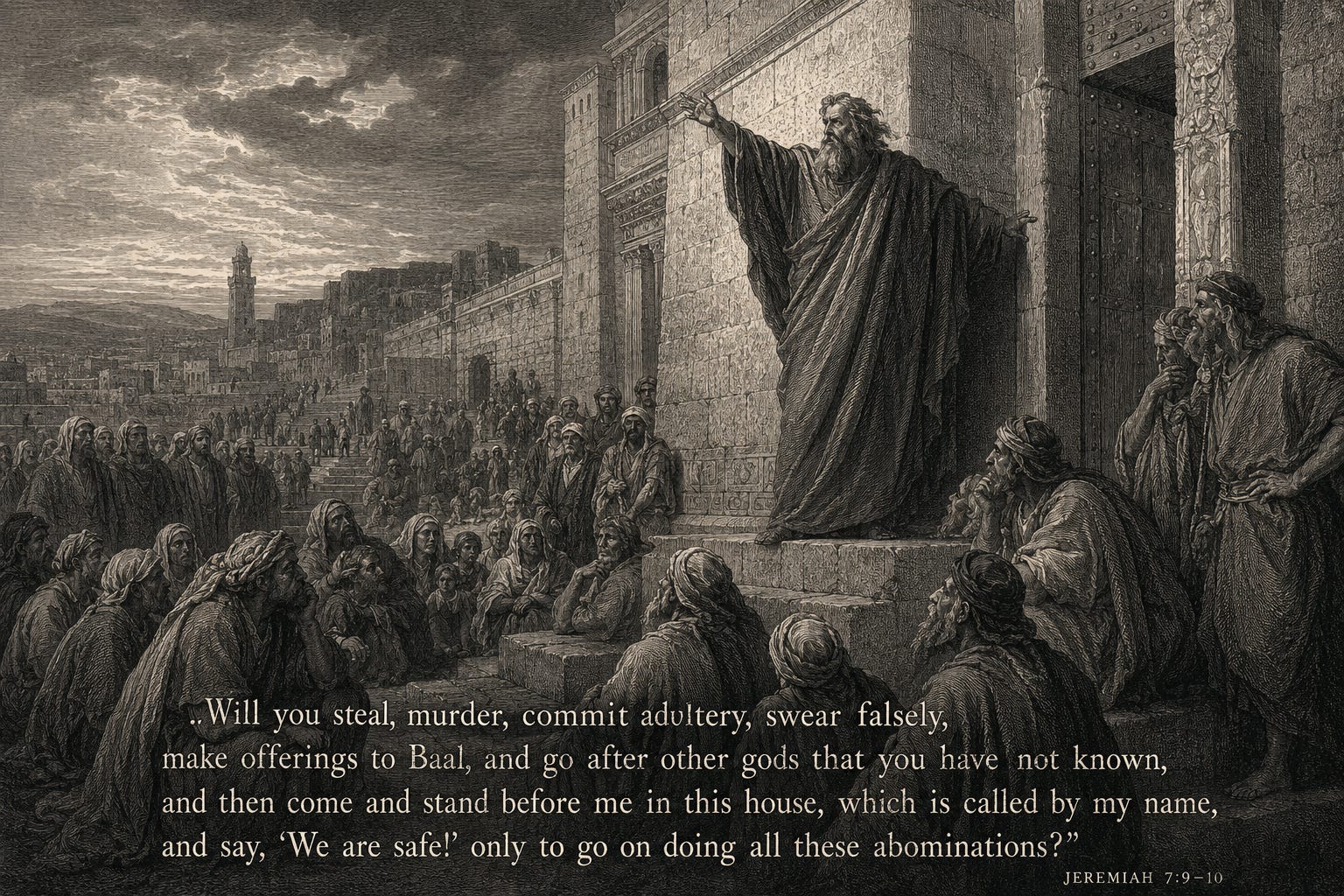
AI generated image in the style of Gustav Doré.
When Jeremiah preached this sermon, the people in the gate did not hear it as a theological diagnosis spoken in love. They heard it as a threat.
Jeremiah was seized by “the priests and the prophets and the people. ‘You shall die!’ they said.”7 He would have been killed except that some older men remembered that Micah of Moresheth had said something like it once before and Hezekiah hadn’t killed him for it.8
This is what will happen the first time this essay is read, the oldest documented version of rage. It is what happens whenever a priest or leader speaks against the public lives of its church members and those around them.
Yet, the naming of sin and evil is essential to the basic and fundamental project of God’s grace. The community built around a religious identity it is actively betraying will not welcome the naming. It will hear the naming as the attack on identity it is. The naming will feel like a political accusation made by enemies, a breach of solidarity exploited by outsiders, a terrifying intrusion into the safety of the identity politics it has come to rely on for comfort and stability. It will want the prophet silenced. And, we are already seeing public pressure put on clergy for not talking about the sin that is in us.
That is the danger to the community. Not that it will be wounded by the naming. The danger lies in what the community does when the naming is silenced. When Jeremiah was silenced, the people of Jerusalem continued to worship their demigods from behind the safety of the Temple’s name. They did so until the Temple was destroyed and they were taken into exile. Silencing the prophetic voice doesn’t preserve the community. It allows the completion of the demigod’s colonization of the faithful.
This essay names the demigods. It may be experienced as an accusation; yet, I urge you, dear reader, to give this a thought. But we experience it as an accusation because it is true. Truth hurts. Literally speaking. When faced with a truth, especially a hard one, our brain’s first reaction often isn’t clarity, but danger. When someone says something that highlights the discrepancy between how we think we act and how we actually behave, our first response is often that we feel hurt. The hurt comes less from what they’re saying and more from the realization that they’re actually right.
What we know, though, is that the community that cannot hear the differing voices naming its demigods has already lost the language it needs to understand what is happening to its faith. When we have lost that language, the very words of our faith become tools for any political agenda that needs the masses rallied in its service. Our demigods take the name of the LORD, and we say, “We are safe.”
I. Public Theology and the World Already Full
Someone recently told me they thought public theology was little more than mouthing Christian concepts in words people can understand. In a way, yes, that is true, and thank goodness it is true as far as it goes. But what is truest of all about public theology is this: public theology assumes and proclaims that we live our public lives already soaked in theology, whether we know it or not, whether we have words for it or not.
In our sense of things as Episcopal Anglicans, we live theological lives based upon the bible, the tradition of the first councils of the church, and the reason of discipleship decisions through our own councils and conventions (these depend upon our reason as individuals and our reason as contextually based churches experiencing the lives of their members and neighbors). This is why we must understand we are theologians doing theology in our lives and in our bodies.
“The experience of being perceived and understood that you bring, tacitly, to everyday encounters is a theological fact. It is the creature’s sense of having already been addressed.”3
We believe that “through him all things were made.” This article is not about the inner triune life of God…Through Christ all things were made means also that in being made all things receive their address…. If Christ Jesus is homoousios—the same substance as—the Father, then the originating event of creation was fully God and every thing that flows forth from that originating event is fully and originally God’s address.”4 The other way to say that every thing was spoken into its being is that the Word became flesh in Palestine two thousand years ago. It all hangs together because the Word sustains it together.
When things don’t fall apart they don’t fall apart because the world is silent. In fact, the world is never silent. It is always already speaking. It is bombarding whatever created thing might be attentive enough to receive that bombardment with its prior meaning. Human creatures are born into a world already leaning toward them in attentive openness. Already inhabiting what the Anglo-Saxon Christian tradition called hersumnesse: listeningness before what already addresses them.5
When you feel known walking across a field or doing dishes it is God’s own real and essential addressedness pressing out forward through the flotsam and jetsam of creaturely contingency into your particular perception. You didn’t make it happen. You just received it. And it matters that you received it before you were capable of explaining it away. It washed over you before your mental constructs could get their hands on it, which means it came from outside your normal cognitive processes, which means it was real in ways your mental constructs can’t grasp.
Part of what public theology does is allow people to consciously inhabit this reality. Most people already live there by default. The question is whether they live there by default or by awareness. Or, by an awareness that becomes default. And the difference between those questions predicts whether the grammar of your life will be shaped by demigods or by the one true God who created all things by addressing them into being. God’s people were always already inside that reality.
The problem faced by every prophet from Hosea to Jeremiah to Amos was that the people had chosen to live there by default. They had defaulted to some other power as central to their understanding of why there is anything at all, instead of listening to what was already addressing them. The prophets were not presenting the people with a new theological idea. They were naming the reality that the people were already living under. You live, we live, under false gods and demigods as our default habit and we do not like to have that pointed out.
II. Whose Image Is This?
The Pharisees and Herodians thought they had Jesus caught on the question about paying taxes to Caesar. Jesus asks to see a coin. “Whose image is this, and whose title?” Caesar’s, they replied. “Give therefore to Caesar the things that are Caesar’s, and to God the things that are God’s.”6
“Whose image is this?” is precisely the diagnostic tool we need for the default disease this essay diagnoses. It belongs to Caesar. The coin bears Caesar’s image. It belongs to Caesar’s order. You and I bear God’s image, the imago Dei of Genesis 1:26-27. We belong to God’s order. The question of public theology, then, is not, “do you confess yourself to be a Christian?” It is, “whose image does your life bear?”
When people consider your life from the outside, whose face do they see? What has formed you? What have you loved enough that it has impressed itself on you so that it orders how you understand yourself, your loyalties, your default reactions to the world’s requirements? Who has “won your mind?”8
The demigods produce formation by impressing their image on the creature. The football franchise impresses its colors, its heroes, its wins-and-losses narrative, its win-or-die language, its in-group-us-versus-out-group story onto the person who submits herself to it in loving devotion. The brands do branding in ways that offer not only immediate recognizability but also tag their human supporters with identity and belonging; the whole concept of branding is no longer merely about recognition or loyalty, but about discipleship—something Apple, especially under Steve Jobs’s leadership, mastered with remarkable clarity—and this same dynamic can be seen in Coca-Cola, Nike, Louis Vuitton, Zara, Adidas, Puma, and Lululemon, all of which cultivate communities of embodied allegiance, aspiration, and self-understanding through the rituals of consumption and affiliation.
Consider the vestment of a clergy person who puts on clothing that makes identification real. Then consider clergy who wear the same clothing but tag themselves with buttons on their blazers and collars, and what that says about the vesture.
The political tribe impresses its friends/enemies map, its righteousness language, its us-versus-them account of who the real Americans are and who the threats are onto the person who lives there long enough. The nationalist ideology impresses its founding myths, its exceptionalist story, its sense of the chosen people, and the designated enemy onto the person whose body has been shaped by its rituals of rally, anthem, and flag. It is so strong that each political party in the extreme refuses help from members of the other for fear of being targeted as collaborating with the enemy, even when it is beneficial to all Americans, regardless of party affiliation.
The creature manifests the image of the object it worships. This is not poetic language. This is a straight-up anthropological description of how our hearts get shaped. James K.A. Smith, building on the Augustinian tradition, argues that the fundamental form of human identity is not rational but material: we are worshiping animals. And we are formed by the liturgies we participate in before we are informed by the doctrines we assent to.7 Worship is primarily not cognitive but embodied. What you do day in and day out, what community you live in, what story you tell yourself, what loyalties you practice: this is what forms the image your life bears, whether you like it or not, whether you say you believe something different or not.
“What does your life worship?” is the question the church must ask of itself first before we dare to ask it of our culture. Whose image does this community’s life bear?
I know the bishop has gone and is now meddling. I am messing with your business now. Look at its budget. Look at its calendar. Listen to its pastors. What shocks its conscience? What produces its deepest angers and fears and satisfactions? If your church cares more about strangers in our land than its local football team, it bears the image of Christ. If the poor in your midst, the hungry and unhoused, produce less collective anguish than your team’s first-round playoff loss, your community bears the football demigod’s image more than it bears God’s image. This is pastoral; it is not political. It says nothing about policy. It is only describing the effect of worship upon our minds and bodies.
The job of the public theologian is to hold up the coin and ask, whose image is this? And to do so, knowing full well that, to the community unable to love it as a diagnosis, the question will sound like an accusation. And it will sound like an accusation because the grammar needed to hear it otherwise, needed to make sense of the question as an act of love rather than an attack, has not yet been formed. That is why the public theologian must ask the question from inside the community, not at the community. The coin question can only be asked by those who bear its precarious vulnerability to the same demigods, who can ask of herself in honesty before asking it of anyone else.
I find myself lacking, and I know every day I have to pray for deliverance from these gods, admission of my own sinfulness, reorient my life, and ask for strength for the journey today.
Let me be clear, most Americans are political first, thus evidencing some kind of electoral preference that drives them to find a church instead of doubling down on their relationship with the divine and then figuring out how to intervene in the powers and principalities who create the inequality and injustice in the world. Jesus said, “The poor will always be with [us.]” (Matthew 26:11, Mark 14:7, and John 12:8 26:11, Mark 14:7, and John 12:8) This is a divine reminder that the powers of this world will always make it so; we always have a hand in this when we have free market, investments and consumation as a driving force for what is considered good. It is just the nature of a fallen world in which we live and move and have our being as fallen, sinful human beings.
III. The Prophetic Witness: National Identity and Its Gods
The prophetic witness of the Bible is, from one perspective, a long meditation on precisely this situation. The scripture tells us of a covenant community that clings tenaciously to the covenant name while ordering its national life around allegiance to other gods, and then treating the prophetic proclamation of this condition as violence toward their identity rather than love.
I am not the only one who believes this way. Consider Rabbi Jonathan Sacks, may his memory be a blessing. My observation captures a central, recurring theme in Rabbi Lord Jonathan Sacks’ theology, particularly in his writings on prophecy, covenant, and national morality, found in his Covenant & Conversation essays and books like Not in God's Name.
Hosea’s master metaphor is as intimate as one can imagine: Israel as an adulterous wife who goes after the Baals but keeps taking care of business under her husband’s name. “She did not know that it was I who gave her the grain, the wine, and the oil, and who lavished upon her silver and gold that they used for Baal.”11 The false gods of fertility and prosperity and national safety, the Baals worshipped in Canaan, received the worship due to the God who made those gifts possible. The name stuck. The fidelity had shifted. This is the simulacrum as it looks through prophetic eyes: the label “Israel” emptied of its covenant reality and redeployed as a cultural identity organized around the Canaanite demigods.
Amos calls Israel to account at the height of its northern affluence. He names this god of national riches with surgical precision that hasn’t softened after twenty-five centuries. “Alas for those who are at ease in Zion, and for those who feel secure on Mount Samaria... who lie on beds of ivory, and lounge on their couches, and eat lambs from the flock… but are not grieved over the ruin of Joseph!”12 They were worshipping their own comfort and ease. It was worshipful enough. They could sing psalms about it if they wanted. The community stacked the sacrifice of prosperity on the altar and bowed before it as part of its regular course of liturgical devotion. The name of the LORD was not ripped out of their mouths. But the community's life proudly bore the image of the demigod. When Amos names this, Israel does not welcome it as gracious love but calls them back to covenant faithfulness. Amaziah the priest tells Amos to return to Judah, where he belongs, and to stop prophesying against Bethel, because Bethel is the king’s sanctuary and belongs to the dynasty.
Amos’ ejection from Bethel is latent in every community that organizes its religious identity around the demigod of national prosperity. The priestly objection isn’t theological objection at all. It’s political self-interest: this prophetic proclamation is attacking the king’s sanctuary. That sanctuary exists to make holy the national compact, and anyone who will not give a venturesome sermon after a sermon bolstering that arrangement is not the servant of the God who meets at that sanctuary but its opponent. The prosperity demigod has thoroughly infused its language into the sanctuary that should’ve resisted it. The prophetic word is heard as sedition.
God’s vision of what happens to a nation that worships at the shrine of prosperity, as described in Isaiah, is the fullest description of the process’s endpoint. “Their land is filled with silver and gold, and there is no end to their treasures; their land is filled with horses, and there is no end to their chariots. Their land is filled with idols; they bow down to the work of their hands, to what their own fingers have made.”13
All of the powers that human hands can create to project dominance and influence: economy, military might, technology. The list becomes demigods when human beings start treating them as such. They’re not worthless. But they’re turned into gods when we make them ultimate. When we bow down before them and organize our national life around serving their power. Isaiah doesn’t say that having silver and gold makes you an evil nation. He says that you worshiped it. Which means the land bears its image.
From Hosea to Jeremiah, Ezekiel carries the painful implications out with brutal logic. If a community lives under the covenant name but orders its national life around allegiance to the gods of prosperity, security, tribal superiority, and military power, then eventually the covenant name and the national power source will come into conflict. And if you trusted your identity to both…which will you choose? Prophetic proclamation naming this reality in its nascent stages is the community’s only prophylactic. When you silence prophetic proclamation, you’ve kicked away your only protection. Exile isn’t God ratifying his abandonment of covenant promises to Israel. It’s Israel punished by the God it refused to worship for years and years in a slow-motion apocalypse fully reported, completely preventable, and warned about repeatedly.
IV. Jesus and the Demigods of His Moment
Jesus’s ministry takes place within a religious community whose sense of national identity had fused completely with its religious identity. What did it mean to be Israel? Who was the true Israel? How did the God of biblical Israel relate to Roman occupation? What would the messianic hope look like when it came? These were both theological and political questions, and the demi-gods they produced were powerful and particular.
The Zealot demi-god was the demi-god of national liberation: that faithful biblical Israel was meant to violently resist Roman occupation, and that God would vindicate that resistance by miraculously delivering Israel from its enemy. Many did before Jesus’ own time - read the Apocrypha. Jesus resisted the demi-god of Rome and religious political leaders relentlessly. The crowd tried to make him king over them after the feeding of the five thousand, and he departed from them.11 He chose to enter Jerusalem riding on a donkey rather than a horse, intentionally opting for the animal that signaled kingship coming in peace rather than the galloping stallion of military conquest. He told Pilate, “My kingdom is not from this world.”13 Jesus directly refused the demi-god’s claim that earthly politics-militarized might equal God’s coming Kingdom.
The Pharisaic demi-god was the demi-god of religious respectability and communal boundary maintenance: that holiness required separation from the unclean, that the covenant community was visibly marked by its observance of those boundaries, and that the religious leaders’ authority derived from their role in policing them. Jesus confronted this demi-god head-on. He ate with tax collectors and sinners. This was the specific kind of boundary violation that made the operations of that demi-god visible. He touched lepers. He healed on the Sabbath. He let women walk with him as disciples. He named the demi-god through the most provocative thing possible: living its alternative.
The Herodian demi-god was the demi-god of accommodation: that community’s survival required peace with the prevailing authorities of the age, that negotiating the realities of Roman occupation was the best political wisdom available, that the Temple status quo’s ability to function depended on its willingness to accommodate Caesar’s rule. The religious leaders of both the empire and the faith asked Jesus about paying taxes together. Note who asked it together: the demi-god of communal boundary maintenance and the demi-god of pragmatic accommodation joined forces against the threat of the prophetic voice. Jesus answered in such a way that he rejected both demi-gods in the same breath. The coin has Caesar’s image on it, and so it belongs to Caesar’s order. The human creature has God’s image in them, and so we belong to God’s order. No negotiated compromise with systems of power can trump what it means to bear the image of God. Moreover, even the coin comes from God as it has in fact attempted to remake what is God’s into something that is political and private.
Jesus’s Temple cleansing is the Jeremiah sermon reenacted. His prophecy was voiced in the Temple courts. He goes into the court of the Gentiles and drives out those who had made a house of prayer into a den of thieves. The demi-god of commercial religion, worship as an economic transaction of sacrificial animals in exchange for divine pardon, had colonized that space, the space meant for Gentiles to access the God of Israel.12 Those who needed that space most, the Gentiles who lived with the occupied land but outside of the covenant community’s course, found it inhabited by a god. Jesus names this phenomenon through action rather than argument. He flipped over the tables. The chief priests and scribes saw the children crying “Hosanna” in response to Jesus’ action and began looking for ways to kill him. Enacted prophetic speech generates the same instinct that the priests and nobles generated in response to Jeremiah’s sermon: the institution organized around the demi-god will seek to silence the prophet’s voice.
Jesus’ answer to the coin question ties all these episodes together. Whose image does it bear? Some religious leaders bore the image of rebellion. Some images bore law-keeping. For others, the image was a collaboration with the powers. The Temple priests’ image was commerce. All were using the language of covenant faithfulness. None looked like the coming Kingdom. Jesus practiced the coin question throughout his ministry. He asked it patiently. He asked it consistently. It cost him everything to ask and embody that question in community with those who were willing to live it.
V. The Default Mode and Its Modern Demigods
David Foster Wallace titled his 2005 Kenyon College commencement address “This is water.” The default mode of adult human consciousness, he said there, amounts to “deep and literal selfishness.”
The default orientation toward reality is the felt sense that the world is there to serve you, that everyone in it is there to play a role in your happiness or your pain.13 His point was simply that Western consciousness in the theological vacuum defaults to Cartesian dualism instantiated as experience. Value thrown outward by human minds onto an otherwise valueless universe, the creature constitutes itself as the source of all meaning in a world of inert matter. 14
The insistence that everything is either dead atoms or meaning-making creatures responsible for nothing beyond their own cognition has not banished divine address from the world. God has not unplugged the Matrix so much as his creatures have trained themselves by powers and demigods to stop listening to it. The world is never silent, never stops speaking. Long before evangelicals tweet Bible verses at our political opponents, the world is speaking to those opponents and those evangelicals. The world is always already speaking, always already freighted with the prior meaning it presses outward toward any creature attentive enough to receive its address. The creature who experiences reality as the “blind ghost” Wallace describes,15 does not exist in a cosmos silenced by fiat. That creature exists in a universe screaming with divine address it has trained itself, and been trained by its civilization, to ignore.
Augustine diagnosed the process that produces this condition with great precision. It cannot be improved upon: the human heart is shaped by its loves, and it will worship what it loves most deeply.15 The creature cannot stop worshipping. The only question is never whether it worships, but what it worships. Idolatry always fills the void left by true worship, and when the grammar of hersumnesse has been overwhelmed by the grammar of autonomous self-constitution, worship does not go away. Worship intensifies. It finds the most compelling objects of loyalty that culture makes available and redirects itself toward them.
The gods of modern public life are obvious when you are looking for exotic examples. They are far less obvious when you recognize them for the organizing loyalties of ordinary life. They are boring. They are so impactful because they are familiar and unremarkable; because they shape lives and communities not in conscious engagement with theological questions but below that level, out of sight.
Your local football franchise provides narrative, community, belonging to something larger than individual life, the drama of genuine encounter between good and evil, and all the structural and functional needs worship is built to meet, without making any ludicrous claims about competing with the God who actually meets those needs. Your political tribe gives you moral seriousness, easy enemies, the feeling that justice is on your side, and community with the people you’ve decided are like-minded enough to be your friends. All without requiring you to pay the costs that a genuine covenant community demands.
The demigod of national identity offers the satisfying-if-not-entirely-accurate narrative of providential national destiny, the pride that comes from belonging to the people who history chose, and the clarity of having a clearly defined story about who the outsiders are. This is all way too easy and requires no difficult thinking.
Each of these forms has an image. Each of these communities impresses that image on the human who yields to it and inhabits it long enough. The person who has faithfully sat in the same seat for every home game their local franchise has played for thirty years but has missed church for twenty of those years has still been formed in and by a liturgical community. The question is: what image has the community’s teaching impressed on the soul? The person whose politics cause stronger feelings than any theological doctrine does is being formed in worship by an intense rival community of practice. The person whose highest daily anxiety is the stability of their portfolio is being formed linguistically in a grammar of trust whose object is her own bank account rather than the God who holds things together.
Christian nationalism, that fusion of religious language with contempt for the political other and triumphalist fantasies of cultural destiny, is the most potent force facing Christians right now because it offers the best of all these alternatives rolled into one and packaged in the Church’s own language. It gives you the tribal belonging of your political identity, the narrative arc of your country’s manifest destiny, the moral gravity of fighting for civilization itself, and all of it blessed by the sanction of Christian authority. It takes existing demigod worship coursing through the lives of observant, morally serious Christians formed in default Christianity their whole life, rather than in the grammar of the Kingdom, and pumps adrenaline into it. It gives worship what it has always wanted: a more focused, more political, more overtly sacred object.
Christian nationalism does not introduce idolatry to Christianity. It finishes the job of evacuating God that soft, delightful powerlessness started. It takes advantage of a generation’s, or more, lack of true formation.
VI. Why the Objection Is So Dangerous
The objection this essay provokes will be familiar and should be stated plainly: people don’t like to hear that they may unwittingly worship a demigod. Or worse! That they helped create, like golden calves, the demigods themselves. That, despite their best intentions, apart from any conscious apostasy of which they are aware, they may be structuring their lives around a god other than the Creator of heaven and earth.
Objectors will put it in several ways. Sometimes they will frame it as an objection on the grounds of sincerity: I am a Christian. I believe in God. I go to church when I can. I worship Jesus with my sports team logo t-shirt, not the other way around. Sometimes they will put it as a theological objection: this conflation of cultural membership with theological fidelity is naive. The church has always been of the world, and culture doesn’t come with icons that say, “Do not worship by default.”
Sometimes the objection will come in political form: this accusation is just thinly veiled Christian-phobia, expressed in theological terms to give it an illusion of nonpartisanship.
Each of these objections deserves serious consideration. The person objecting from sincerity is correct that sincerity is important, but incorrect to suppose that sincerity is enough. Jeremiah’s audience was sincere. The people who gathered at the Temple gate thought themselves good people. They sincerely believed they were the Lord’s people. Sincerity did not inoculate them from the operations of the demigods. It facilitated it. To sincerely believe one already belongs to the right community is the precise belief that makes the work of the demigod invisible. The demigod does not require conscious affirmation from worshipers. It requires the prophetic voice to go silent. Left to its own devices, the sincere Christian and the worshiper of demigods can be the same person.
The person objecting from theological naiveté about culture is correct that the church has never been apart from culture, but incorrect to assume that therefore culture is theological indifferent. To ask the coin question is not to demand cultural exodus. It is to ask whose image our cultural practices have formed us in. And, what does it mean to evidence God in our lives through our devotion? To “not be conformed to this world,” as Paul instructed the church in Rome, is not a call to cultural isolationism.17 This is not a call to be part of the Benedict Option. It is a call to formational practices that make a community whose life together-image-bears little resemblance to the cultural default. The question is about formation, not cultural participation. When the church participates in the surrounding culture without asking whose image it is forming, it has failed in its fundamental formative task.
The person objecting with political skepticism is asking important questions about the wrong essay. Progressive ideological rigidity functions every bit as much as a demigod of modern American Christianity as nationalist loyalties do. The church that centers its political progressivism as the organizing principle of its Christian witness has taken the image of the progressive demigod just as surely as the church that centers its nationalism has taken the image of the nationalist demigod. The coin question must be asked of churches in both directions, without exception. If the public theologian only applies the question to political opponents, then they have already answered the coin question for themselves.
Plainly, then: the objection secures the work of the demigod. It does not need to defeat the argument. It only needs the prophetic voice to fall silent. When Amaziah told Amos he should stop prophesying at Bethel and return to Judah, the demigod of national prosperity did not need Amos to agree with its theology. It only needed Amos out of its sanctuary. The church that successfully objects to the naming of its idols has not rejected the presence of the demigods. It has secured their free rein.
Unfortunately, our preaching has tended to create such silence and full rein, or it has taken one or the other political sides of the divide, thereby assuring tribal political allegiance in the congregation.
Christian nationalism followed this pattern for decades. The churches and institutions most dominated by Christian nationalism were the same churches and institutions that loudly and repeatedly objected to any effort to name the forces at work within evangelical Christianity. Some saw Weyrich’s manipulation early on, but the chorus of voices objecting to the naming, claiming that the very act of naming was a political speech act weaponized against Christians, was loud enough and sustained enough to render the prophetic voice moot in most evangelical spaces. By the time the nationalist demigod had fully colonized the evangelical grammars of church, theology, and politics, I argue, there was no formation alive within those spaces that could hear the question as anything other than a threat.
The objection itself is not the danger. The danger is theological foreclosure. When the church cannot hear the naming of the demigods it has worshiped, it has rejected the grammar within which it might be brought to repentance. It has chosen, in Jeremiah’s words, the deceptive words and trusted they were safe, while the demigod quietly builds its altar in the courtyard of the Lord’s temple. The prophetic voice calling attention to the demigods’ action is the last line of defense for the faithful community. Silence that voice, and you do not protect your community. You surrender it.
VII. Disciples and Apostles: The Formation That Resists
Let me push slightly to say that the church’s culpability in producing the people targeted by CN must be named honestly before that response will be credible. The demigods seized the grammar of Christianity not merely because American culture is hegemonic (though it is), but because the church stopped forming disciples and started producing church members.
Discipleship vs. membership is important theologically. The church member has an affiliation. The disciple lives by a grammar. The church member’s identity has been shaped by the culture, and church membership has been grafted onto that identity as one identifier among others without challenging the core loyalties already formed.
The disciple’s identity has been formed in the deepest places of life through participation in the community’s common life, until the grammar of the Kingdom becomes the lens through which everything else is judged. The church member can buy NFL tickets, golf course, or soccer games, and swear allegiance to the flag because neither American consumerism nor American nationalism has taken deep enough root to conflict with one another. The disciple won’t because their training has taken deep enough root that competing loyalties become visible and expensive.
One sent into the world on an apostolic mission will only bear the cost of that coin question when asked of another to the degree they’ve asked it of themselves. Apostleship requires that prior formation be deep enough that sacrificial love is possible, therefore possible to ask of others.
The apostle has eaten at the table with a community comprised of every tribe, political party, and economic level, until primary citizenship there felt more true than the flag’s claim. The apostle has memorized Scripture until the Kingdom’s grammar is so woven into their being that it can’t be unheard when spoken. The apostle has named the demigods at work in her own life before asking anyone else to do that work with her. The apostle can ask “Whose image does this bear?” of the Supreme Court because they have asked it of her and been willing to pay whatever price that answer costs.
The church will produce apostles only when its formation has gone deep enough that the demigods can be named rather than unseen. This kind of formation means practicing three things that the church is usually fastest to abbreviate or abandon.
The first practice is the coin question applied regularly to the community itself. Whose image does the budget bear? Whose image does the calendar bear? What causes the community’s prayers of deepest collective panic? What causes its prayers of greatest collective praise? I’m not talking about budget meetings or schedule meetings. I’m talking about worship seeking the theological answer to those questions. The community that asks those questions of itself regularly in light of Scripture preached, prayed, and pastorally cared for has erected the scaffolding necessary for prophetic speech.
The second practice is rigorous formation in the biblical tradition of prophetic speech: disciplined exposure to Hosea, Amos, Jeremiah, and Isaiah that enables the community to recognize its own idols for what they are, rather than as culture’s necessities. Biblical literacy isn’t about education. It’s about formation. A community that lacks that literacy can’t metabolize the coin question correctly because they won’t recognize it as love if they hear it. They’ll hear it as an accusation.
Dare I go a bit further and suggest biblical literacy in general? Not read on your own, but within community, and within community that understands the fullness of the tradition I spoke about earlier: scripture, tradition, and reason as defined above.
Third is the discipline of gathering at the table. The Eucharistic celebration, which brings together people from every cultural background and political party and tax bracket, proclaims with its very body the image it bears by not bearing the image of the demigods’ homogeneous communities.
To gather at the table with the kinds of people that your demigods use as scapegoats or enemies is to practice radical welcome, not as a political stance but as the mundane outworking of Kingdom grammar. To insist on the integrity of that community across cultural, political, and economic divides is to argue against the demigods not with words but with your very bodies. If you can’t gather with people different from yourselves at the table, your proclamation of the Gospel will fall on deaf ears because the demigods’ deepest lie is that Christianity is just another homogeneous community.
May God form us deep enough that the alternative grammar becomes visible, and may we join each other at the table in the grateful practice of it.
Conclusion: The Coin Question as the Ongoing Practice
Jeremiah named it from the gate of the Temple. He named what the people gathered there refused to hear. They nearly killed him for it. He was not silenced. He named it again, and again, in letters to the exiles, in oracles to the remnant, in poems of lament that became the community’s shared grief when the Temple was destroyed.
The prophetic word outlasted the demigod’s claim on the Temple. The community that returned from exile returned bearing the prophetic tradition that had spoken what they would not hear. The exile was both demigod’s triumph and the prophetic word’s vindication at once.
Jesus demanded the coin. He asked whose image was on it. He asks still. It is the question the public theologian must ask any community, including her own. From out of the vulnerability of one who bears the same liability to the same demigods, who has had her organizing loyalties confronted by the coin question and chosen, again and again, in her own life, the harder answer.
The world speaks before we speak into it. The divine address presses through every moment’s contingencies toward every listening creature. The demigods are powerful not because they have overcome the divine address but because they have reshaped the creature’s powers of perception, turning the ears toward the demigod’s language as the most significant speech available.
The formation that makes possible hersumnesse, that attentiveness to what has always already been addressing us, is the only adequate response to the demigod’s power. Formation isn’t a program. Formation is a community. It is the body whose common life forms us for the kind of knowing the demigod cannot achieve and cannot, in the end, destroy. It is the community that asks the coin question of itself first, before asking it of anyone else; that lives into the alternative grammar until it becomes flesh, until the grammar by which we recognize the demigods as the lesser things they truly are.
We cannot reason anyone into such attentiveness. The prophets could not reason it into Israel. Jesus could not reason it into the religious leaders of his day. The coin question is not an argument. It is naming. And naming, when it issues from within the community rather than at the community’s expense, when it issues from someone who bears the same liability to the demigods and has asked herself the question, becomes itself an act of love prior to being a theological proposition.
Whose image does your life bear? It is the first question of the formation that sets us free from the demigods, that restores us to the one whose image we bear, to the one who pressed through every day’s contingencies two thousand years ago in Palestine and asked the question that has ever since had only one adequate response.
Notes
1. Jeremiah 7:4, 9-10 (NRSV). I recognize that the idea that Jeremiah was on the "side of the Babylonians" is a critical biblical theory in literary and historical criticism. It is a scholarly and theological construct based on an interpretation of Jeremiah's prophecies. This theory does not portray Jeremiah as betraying Judah, but rather espousing that submission to Babylon was the will of Yahweh. I would suggest that regardless of whether Jeremiah was in league with the Babylonians or not, his prophetic words were also true of the people to whom he addressed them.
2. Jeremiah 26:1-19. The narrative of Jeremiah’s arrest and near-execution following the Temple sermon is one of the most detailed accounts of prophetic reception in the Hebrew Bible. The elders’ citation of Micah of Moresheth (Micah 3:12) as precedent for the survival of prophetic naming is the first recorded instance of one biblical prophet citing another as legal precedent.
3. The formulation draws on C. Andrew Doyle’s developing framework for Anglican apologetics, grounded in the a priori God claim and the hersumnesse anthropology, developed across the “Anglican Apologetics and the Informational Universe” essay series, 2026.
4. Nicene Creed (381): “Through him all things were made.” The Johannine prologue (John 1:1-14) is the scriptural ground. For the theological consequence for creation’s always-already-addressed character, see Colin Gunton, The Triune Creator: A Historical and Systematic Study (Grand Rapids: Eerdmans, 1998), 70-97.
5. Hersumnesse is developed as a constructive theological category in C. Andrew Doyle, Obedience, Benevolence, and the God-Saturated Grammar of Subjugation in George Berkeley (doctoral dissertation, University of Chester, in progress).
6. Matthew 22:20-21 (NRSV). The parallel accounts are Mark 12:13-17 and Luke 20:19-26.
7. James K.A. Smith, Desiring the Kingdom: Worship, Worldview, and Cultural Formation (Grand Rapids: Baker Academic, 2009), 25-27, 53-88. Smith’s liturgical anthropology, drawing on Augustine’s ordo amoris and Merleau-Ponty’s phenomenology of embodiment, is the most developed contemporary account of the formation-before-information claim.
8. Hosea 2:8 (NRSV).
9. Amos 6:1, 4, 6 (NRSV).
10. Isaiah 2:7-8 (NRSV).
11. John 6:15 (NRSV).
12. Mark 11:15-18. The Synoptic accounts of the Temple cleansing (Matthew 21:12-13; Luke 19:45-46) all identify the court of the Gentiles as the location, making the displacement of the Gentiles’ access to the God of Israel by the commercial demigod the specific target of the action. For the theological analysis, see N.T. Wright, Jesus and the Victory of God (Minneapolis: Fortress, 1996), 413-28.
13. David Foster Wallace, “This Is Water,” Kenyon College Commencement Address, May 21, 2005. Published as This Is Water (New York: Little, Brown, 2009), 36-44.
14. Charles Taylor, A Secular Age (Cambridge: Harvard University Press, 2007), 134-42.
15. Augustine, Confessions, trans. Henry Chadwick (Oxford: Oxford University Press, 1991), I.i.1; and The City of God, trans. Henry Bettenson (London: Penguin, 2003), Book XIX, ch. 1.
16. Romans 12:2 (NRSV).