
Two Cities, One Body
Public Theology Essay 2 on Christian Nationalism

Somewhere around the year 62, a man sat in a rented room in Rome and wrote a letter to a community he loved in Philippi, a Roman colony in Macedonia. The man was a Roman citizen. He had invoked that citizenship two years earlier in Jerusalem to stop a flogging, and again in Caesarea to appeal his case to the Emperor, which is precisely how he came to be in Rome.1 He was also, at the moment of writing, a prisoner of the state whose citizenship he held. The two facts coexisted without resolution. He was a fully engaged Roman citizen and a man in chains, simultaneously and without embarrassment about either.
The man who wrote Romans, is imprisoned by his state, and wrote one of the most politically charged sentences in the New Testament: “Our citizenship is in heaven, and it is from there that we are expecting a Savior, the Lord Jesus Christ.”2 He was writing to people who lived in a Roman colony whose citizens were proud of their status, whose public life was organized around the imagery and loyalty structures of Rome. And he told them their primary citizenship was elsewhere. Four chapters later, before closing, he added a greeting from “the saints... especially those of the emperor’s household.”3
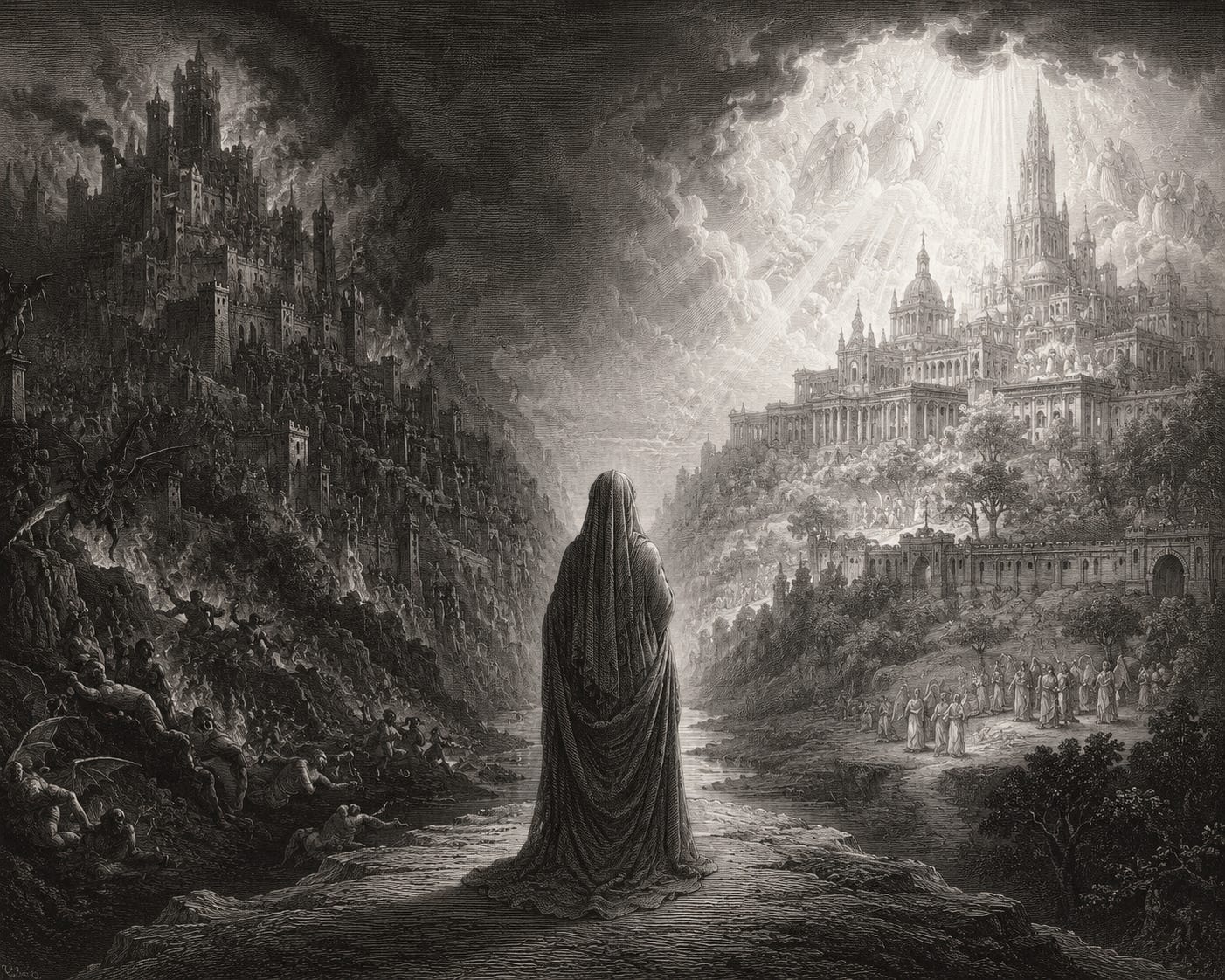
Saints in Caesar’s household? Paul recognized this dual citizenship operating at the center of the empire. Paul did not resolve the tension between his Roman and heavenly citizenships. He inhabited both, used one instrumentally in service of the other, suffered the consequences when the two came into conflict, and wrote his most luminous letters from the place where that conflict had landed him.
Part One of this series argued that Christian nationalism is secularism’s completion rather than its resistance: the evacuation of the theological referent from the Christian sign and its redeployment as a pure cultural-political identity marker. That argument names a structural error (Part One). This essay addresses the question the structural error leaves open: if the conflation of Christian identity and national identity is the wrong relationship between the two citizenships the baptized community holds, what is the right one? And where, precisely, does the slope toward conflation begin?
As I have pondered this, I think the answer to the second question changes everything about the first. The slope does not begin with Christian supremacy, the Seven Mountains Mandate for Christian dominion in the US, worship services at the Pentagon, or prayers for a golden statue. The slope begins much earlier, at a point so familiar it feels like solid ground to many. And the instrument that identifies the beginning of the slope with theological precision is a document produced in Germany in 1934 by a group of pastors who had watched the slope’s full descent and drawn a line at the top before the bottom was reached.
I. The Permanent Tension
The dual citizenship of the baptized is a reality any Christian experiences in the nation where they live. It is the permanent eschatological condition of the community that lives between the resurrection and the consummation, between the Kingdom’s arrival in Christ and its fullness at the end of all things. The tension is not something better theology might dissolve - though many have tried. It is the shape of faithful life in the time of our lives.
Augustine called it what it is. Responding to the sack of Rome by the Visigoths and the claim that Christians were weakening Rome, Augustine in The City of God described two societies that stand throughout history: The City of God, comprised of those who love God above all and see earthly goods as conditional; and the earthly city, comprised of those who place themselves above God and see earthly goods as ultimate.4 The pilgrim community, the Church, resides in the earthly city. We use its goods. We labor to make it prosper. We pray for its peace. But our ultimate allegiance is not to this city. The earthly city is not inherently evil. It is limited. It provides for our conditional goods: peace, order, and civic justice, which are indeed good gifts. They are legitimate goods and should be welcomed with gratitude. It is only when the city makes an ultimate claim to any religious allegiance that it becomes disordered, most especially when it makes a demand on Christians.
Paul’s letter to the Romans makes the same distinction from the bottom up. The governing authorities are God’s servants for the common good, and the community owes them honor, taxes, and respect see chapter 13 of Romans. However, only if the nation fulfills the previous chapter’s notion of faithful leadership in chapter 12.5 The same Paul writes in Revelation’s theological register, through John on Patmos, of the Beast who demands the worship belonging to God and marks its own citizens with a seal that parodies baptism.6 Romans 13 and Revelation 13 are not contradictory texts. They describe the same state at two different moments: the state as servant of God’s order for the common good (Romans Chapter 12), and the state as Beast when it overclaims and demands the allegiance belonging to God alone. The faithful dual citizen reads both chapters simultaneously and holds the tension between them, because both are always potentially true of any state at any moment.
The Anglican tradition has maintained this tension with varying degrees of success and failure. Article 37 of the Thirty-Nine Articles affirms the crown’s authority over the realm and simultaneously insists that the crown cannot perform acts of divine worship or claim the ministry of God’s Word.7 Richard Hooker’s Laws of Ecclesiastical Polity develops a sophisticated account of a Christian commonwealth in which church and state share their membership but maintain distinct functions, each serving the other without collapsing into the other.8 The Erastian temptation, in which the state effectively governs the church, and the theocratic temptation, in which the church effectively governs the state, are both failures of dual citizenship in opposite directions. The Anglican via media between them is not a compromise of principle. It is the theological insistence that both cities are real, both citizenships are binding, and neither may absorb the other.
The dual citizen’s offering to the earthly city is precisely the capacity to serve it from a ground the earthly city cannot provide for itself. The community that holds its primary citizenship elsewhere is free to engage the earthly city’s goods without being captured by its logic, to advocate for the neighbor without becoming the partisan of a faction, to speak prophetically to the political order without becoming a political party. This is not a withdrawal from civic responsibility; rather, it is the most engaged possible civic presence, because it is a presence that refuses to be absorbed.
II. The Two Errors That Resolve What Must Be Inhabited
The permanent tension of dual citizenship is uncomfortable. Discomfort produces the desire for resolution, and there are two available resolutions, each of which fails.
The first error is absorption. This is the error Part One of this series diagnosed as Christian nationalism’s structural condition: the primary citizenship swallows the secondary one, the Kingdom becomes the nation’s program, and a Gospel (sans good news for the poor, the sick, and the hungry) becomes the packaging for a political agenda. The prophetic edge of the primary citizenship, its capacity to hold the earthly city accountable before a God who transcends every national arrangement, is lost at the moment of fusion. Once the church has identified its mission with the nation’s restoration, it can no longer speak the word the nation needs to hear. It has become the nation’s chaplain rather than its prophet. Moses in Pharaoh’s palace rather than Moses at the burning bush.
This error is visible and documented. It is what Paul Weyrich built across three decades of deliberate political strategy: the transformation of sincere evangelical conviction into a reliable partisan voting identity, organized around a designated enemy and sustained by a problem-saturated story that redirected the church’s attention permanently outward.9 It is what the sociologist Matthew Taylor maps across the spectrum from God Bless America sentiment to Christian supremacist ideology.10 It is what Robert Bellah feared in 1975 when he identified the collapse of American civil religion’s prophetic function into the logic of religious nationalism.11
The second error is withdrawal. Because the earthly city makes dangerous claims and the slope toward conflation is real, the temptation arises to disengage: let the church be the church and let the state be the state, and let there be as little traffic as possible between them. This allows both the state and the citizen to live without a conscience check. This is the sectarian temptation, and it has a distinguished theological pedigree. It is not without wisdom.
But withdrawal is itself a political act, and it is one that the dual citizenship framework refuses. Paul does not withdraw to avoid the Roman state. He engages it, uses it, suffers within it, and greets the saints in Caesar’s household. When he invokes his Roman citizenship to avoid the flogging, he is using the earthly city’s structures in service of his mission. When he appeals to Caesar, he is using the imperial legal system to bring the Gospel to Rome. Withdrawal would have been safer. It would also have abandoned the neighbor, the poor, the stranger who needs the church’s advocacy within the structures of political life. The church that withdraws has protected its purity at the cost of its vocation.
Both errors resolve the tension rather than inhabiting it. The conflation makes the earthly city primary. The withdrawal makes the earthly city irrelevant. The faithful dual citizen holds both citizenships simultaneously, in permanent productive tension, using the earthly city’s goods in service of the Kingdom’s mission while refusing the earthly city’s demand that the Kingdom’s grammar be subordinated to its logic.
The question that follows is both theological and practical: how does the dual citizen know when engagement has become conflation? Where does the slope begin, and what theological instrument identifies its starting point with sufficient precision to be useful before the bottom is reached?
III. The Slope and the Barmen Instrument
The Theological Declaration of Barmen was drafted primarily by Karl Barth and adopted by the Confessing Church in May 1934, fourteen months after Hitler became Chancellor of Germany.12 It was addressed to the German Evangelical Church and to its Deutsche Christen (German Christian) faction, which had declared its support for the Nazi program and attempted to align the church’s mission with the national renewal project. The Confessing Church’s response was not primarily political. It was ecclesiological: this is what the Church is, and this is therefore what the Church can be.
The Deutsche Christen did not begin as an explicit Nazis. They began as sincere German Protestants who believed national renewal and Christian faith were compatible and mutually reinforcing. They loved Germany. They believed God was doing something in the German national moment. They wanted to bring these two loyalties together in a way that served both. The conflation felt natural. It felt faithful. It felt like an opportunity rather than a danger.
The Confessing Church did not say: you have gone too far. It said: you began in error. The first step was the false step. This is why the first of Barmen’s six theses is the instrument our time requires:
Jesus Christ, as he is attested for us in Holy Scripture, is the one Word of God which we have to hear and which we have to trust and obey in life and in death. We reject the false doctrine, as though the Church could and would have to acknowledge as a source of its proclamation, apart from and besides this one Word of God, still other events and powers, figures and truths, as God’s revelation.13
The thesis is precise in a way that demands attention. It does not forbid engagement with the political order. It does not demand withdrawal. It forbids the acknowledgment of any event, power, political figure, or truth as a source of theological proclamation alongside the one Word of God attested in Scripture.
Apply the Barmen instrument to the present moment with this precision, and the slope becomes visible at its beginning rather than only at its end.
When American national history is acknowledged as a theological authority alongside Scripture, a source of insight into God’s purposes that the Scripture itself does not provide, the slope has begun. When a political leader’s election is received as evidence of divine favor, a fresh word from God about the direction of history, the slope has begun. When the nation’s success is understood as divine endorsement rather than as a conditional good to be received with gratitude and held with humility, the slope has begun. When the church’s language of blessing is deployed as a legitimating instrument for political programs, making the church’s proclamation answerable to the program’s success rather than to the Word of God, the slope has begun.
Matthew Taylor’s taxonomy of American Christian nationalism’s three currents, the Calvinist Reconstructionists, the Independent Charismatics of the New Apostolic Reformation, and the Anti-Vatican II Catholic integralists, illuminates the slope’s three distinct descent paths.14
The Reconstructionists acknowledge biblical civil law as a political program alongside the Word’s ecclesial address, making theonomy the application of Scripture to governance rather than the community’s formation in the Gospel’s grammar. The Charismatics acknowledge contemporary prophetic utterances about Trump’s cosmic destiny as fresh divine revelation alongside Scripture, making the political figure into a theological category. The integralists acknowledge the natural law tradition as mediated through a specific cultural-political arrangement as a theological authority over the conciliar tradition of the Church itself. Each descent path begins from a different angle. Each begins at the same point: the acknowledgment of an additional source.
The God Bless America nationalist at the mild end of Taylor’s spectrum is at the top of the slope rather than safely off it. The mild form does not worry Taylor greatly, and sociologically he is right: most people at the mild end still try to love their neighbors, still hold their patriotic sentiment loosely enough that it does not yet foreclose the Gospel’s demands. But theologically, the mild form and the extreme form share the same first step. The theological issue is not intensity. It is direction. Once any national event, figure, or narrative has been acknowledged as a source of theological proclamation, the direction is set. The journey to the bottom proceeds by ordinary human logic, accelerated by Weyrich’s problem-saturated story, amplified by talk radio and partisan media, and harvested by the three theological currents Taylor tracks.
The Barmen instrument does not forbid the dual citizen from loving her country, from praying for her nation’s flourishing, from using civic structures in service of the Kingdom’s mission. It forbids the church from receiving any of these as a theological source. The flag in the sanctuary is not the problem. The flag in the sanctuary acknowledged as a symbol carrying a theological claim upon the congregation is the problem. The difference is one the community inside the sign-system cannot see without the Barmen instrument applied from outside. This is why the instrument must be applied at the top of the slope, not the bottom.
IV. The Identified Patient and the Church’s Examination of Conscience
Adam Ellis’s family systems analysis of American evangelicalism’s capture by partisan political identity names what happens to the church’s prophetic capacity once the slope has been entered.15 The identified patient dynamic is the dual citizenship’s failure made sociologically visible. The church has imported the earthly city’s frenemy logic into its own community. The dysfunction the church is called to expose in the political order has become invisible because the church has already adopted it.
When the community organizes its political identity around a designated enemy, the enemy absorbs the community’s full moral attention. Every failure within the community can be explained by the urgency of the threat outside it. Every ethical compromise is justified by the necessity of defeating the identified patient. The church’s examination of conscience, the community’s regular reckoning with its own departures from the Gospel’s demands, becomes structurally impossible. The story has already named the villain, and the story does not permit the villain to be found on this side of the aisle.
This is the dual citizenship’s prophetic function destroyed from within. The church’s most valuable gift to the earthly city is its capacity to hold every political arrangement accountable before the God who transcends all of them, to locate the source of dysfunction within every community including its own, to refuse the logic of the identified patient and insist on the neighbor’s dignity even when the neighbor has been designated as the threat. Once the church has adopted the problem-saturated story, especially around any one person or party, this capacity is gone. The church has become the earthly city’s partisan activist rather than its prophet.
Ellis asks the question a good therapist asks: who handed you this story, and what were they trying to get from you when they handed it to you? The historical record is clear. Paul Weyrich was building a voting bloc, not a theological movement. The evangelical community was not an equal partner in the project. It was an asset being managed. The sincere faith, the genuine moral concern about specific issues, the real love for community: all of it was harvested and put to work for a project the community did not design and was never fully told about. One could argue it is the same with The Heritage Foundation.
The dual citizen’s response to this is the examination of conscience the problem-saturated story forbids. It requires asking, of every political alignment, not primarily whether the policy is correct but whether the alignment requires the community to locate the source of dysfunction exclusively outside itself. It requires asking whether the church’s moral energy is directed toward the neighbor in need or toward the enemy to be defeated. It requires the willingness to criticize one’s own political allies by the same Gospel criterion applied to one’s opponents. This is what William Temple called the Church’s prophetic distance: the refusal to be owned by any political program, the maintenance of the critical perspective that comes from holding primary citizenship elsewhere.16
The bishop who has signed every statement against Christian nationalism from the right and no comparable statement about the progressive capture of the Church’s vocabulary from the left has not escaped the problem-saturated story. The bishop who applies the Barmen instrument only to political movements they oppose has not applied the Barmen instrument at all. The dual citizenship’s prophetic function requires the willingness to draw the line at the top of the slope regardless of which direction the slope descends. A church neither may be the Republican Party at prayer; nor the Democratic Party at prayer. And, it may not be silent in the face of oppression or immorality.
V. Three Witnesses to Faithful Dual Citizenship
The dual citizenship, faithfully inhabited, has a shape that is visible in specific human lives. Three witnesses illuminate what it looks like when both citizenships are held simultaneously and in productive tension.
Dietrich Bonhoeffer remained a German citizen throughout his life and loved Germany with what he called a “painful love,” the love of one who sees clearly and refuses the comfort of illusion.17 He used his German citizenship, his connections, his capacity to travel, his Abwehr cover as tools in service of his primary citizenship’s demands. He engaged the earthly city fully, at every available level, precisely because his primary citizenship gave him the freedom to engage without being absorbed. He was hanged by Germany on April 9, 1945, three weeks before Germany’s surrender. The earthly city executed him for the faithfulness of his primary citizenship. He did not experience this as a contradiction. He had known from the beginning that the two citizenships would eventually conflict, and he had known from the beginning which one would hold when they did.
Desmond Tutu engaged apartheid South Africa as a South African citizen and as a citizen of heaven simultaneously, and the power of his witness derived from both. He used every available civic and legal structure in the fight against apartheid. He also told Prime Minister P.W. Botha with a straight face, in the middle of the darkest period: “You have already lost. Why don’t you come on over to the winning side?”18 This was not bravado. It was the eschatological freedom of the dual citizen who knows that the earthly city’s victories and defeats are real but conditional, and that the primary citizenship’s ground lies beyond the earthly city’s power to grant or revoke. Tutu was the most effective political force in his country’s transformation precisely because he was most completely formed by his primary citizenship. The two were not in tension in his witness. They were in productive relation: the primary citizenship gave the secondary one its prophetic power.
Martin Luther King Jr. and the eight thousand people who crossed the Edmund Pettus Bridge on March 21, 1965 enacted the dual citizenship’s most complete public expression.19 They were American citizens asserting constitutional rights the state had systematically denied them. They were also baptized Christians practicing the Kingdom’s grammar of neighbor-love, human dignity, and the refusal of every human arrangement that treats some persons as less than the image of God. The two citizenships were in productive tension rather than conflation: they were American citizens the state had refused to treat as such, and they were citizens of heaven who knew that their dignity rested on a ground the state could deny but could not destroy. The march was a civic act and an ecclesial one simultaneously. Its power came from both.
What all three witnesses share is the refusal of both errors. None withdrew from the earthly city’s structures. None conflated those structures with the Kingdom’s grammar. All three used civic goods instrumentally in service of their primary citizenship’s demands. All three were willing to suffer the consequences when the two citizenships came into conflict. All three drew their prophetic power from the clarity of their primary citizenship rather than from the sophistication of their political strategy.
VI. What Faithful Dual Citizenship Demands Now
There are implications here for how the church thinks about public theological work in the here and now. Speaking of dual citizenship in generalities leaves us open to the criticism above: I as an author am constantly tempted to offer cliché-saturated stories in reverse: generalities about dual citizenship as a way of avoiding the hard stuff. So allow me a bit of specificity:
We must apply the Barmen Declaration to our political alignments prophylactically rather than waiting for them to conflict with orthodox theology. The church needs the Christological formation our forebears in the CRC were missing at the beginning of the Barmen story. We must name the false gospel at the moment political allegiance to the nation asserts itself as providing theological guidance–on either side of the political spectrum. The pastor who declares the 2016 election as the miraculous doing of God and the pastor who declares the 2020 election as the miraculous doing of God are both baptizing political events with the church’s authority. They have made the same theological mistake in opposite directions. The church that only applies Barmen to the errors of the folks on the other side of its sanctuary has not learned the lesson of Barmen. The instrument is meant to protect our primary loyalty to Christ, not give us a partisan weapon against those who disagree with us. Confusing the two is itself the great error of conflation.
Turn the identified patient dynamic on its head institutionally, not merely relationally. The church must build structures that guard against it into its regular practice. This means regular preaching and practice of the self-examination that the problem-saturated story impedes: examining ourselves as community regularly with the Gospel’s criterium, looking for the dysfunction in our own alignments before we point it out in others, engaging in the examination of conscience that our dual citizenship mandates.
Learn to use political goods without worshipping them. Paul uses his Roman citizenship; he submits to its consequences and is executed. He neither throws it away in allegiance to Christ nor treats it as ultimate. We must use the goods of the earthly city. Democratic processes. Legal structures. Civic institutions. Use them in relentless service to the requirements of the Kingdom: caring for the poor, protecting the immigrant, demanding the law be applied equally to all. But the church must use these goods and let none of them become ultimate.
Make the citizenship of our primary allegiance visible in the life of the earthly city. We proclaim the first by showing up as the latter. Gathered at the table from every tribe and tongue and cultural division the earthly city uses to rank and sort people? That’s our primary citizenship being public about who we first belong to. Welcome the stranger across that table because at that table is set by the one who was himself the stranger. Pray for those who persecute you because our Lord who commands us to demonstrate our primary citizenship to him by praying for our enemies. Love your neighbor as yourself because the community that practices this one command from inside the borders the world uses to separate Christians from our neighbors is enacting the one great way our primary citizenship changes public life.
Christians exercising our primary citizenship together is thething itself when it comes to the Citizen Framework. It’s the most complete expression of alternative citizenship: the baptized community as alternative polis, a demonstration that people from every tribe, tongue, race, political party, economic class can live together because our final tying together is in Christ. It’s what happens when you take Jesus’ oneGreatCommand seriously. The church as the sign that points to the coming of the Kingdom from beyond the walls of every human political program, judging all of them by whether or not they adhere to the single command Jesus named in Matthew 25: Whatever you did for the least of these you did for me. The church that lives inside that criteria worship sacrifices nothing to the gods of this world, because it instead it gives itself to the work of making disciples from every tribe and tongue and people and nation. The church that inhabits its primary citizenship makes its most powerful public theological statement by simply being the church.
Conclusion: The Freedom of the Dual Citizen
Return again to Paul, this time to Rome and to his rented room there. Return to the sentence he writes toward the end of his letter to the Philippians a few paragraphs before closing: “I have learned, in whatever state I am, to be content.”21
We often read this sentence as if it described a private spiritual victory, an inner evenness of spirit unaffected by circumstance. It is more specific than that, and more public. It is the fruit of faithful dual citizenship, fully inhabited. Paul writes this from a Roman prison cell. He has been beaten and imprisoned by the earthly city whose citizen he also is. He has been shipwrecked and left for dead. He has utilized every civic structure at his disposal for the sake of the mission entrusted to him. And Roman civic structures have executed him for his faithfulness. But his contentment is testimony that he belongs first where they cannot reach him.
Paul’s freedom is not the inert calm of the person who has withdrawn from civic structures in the earthly city. It is the freedom of the person most fully present within them because her primary citizenship liberates her from dependence on the earthly city’s approval, its rewards, or its protection of the integrity of her primary identity. He is free to address Rome for the sake of Rome because Rome cannot finally contain him. Paul can utilize Roman citizenship because he is not, ultimately, a Roman citizen. (I think this is the core of Stanley Hauerwas and Will Willimon’s theology.) Paul greets the saints in Caesar’s household because he knows Caesar’s household, like every human institution with power over its members, will be held within the sure sovereignty of the one whose set apartness causes every knee to bow.
Imagine the church inhabiting its dual citizenship with this kind of freedom: loving its present place with the love of the one who knows it is not home. It would be the most revolutionary community the earthly city has ever known: free to serve it without dependency, free to love it without yielding divine worship, free to speak truth to it powers without fear of being silenced by it, free to be executed as its enemies while writing letters from prison that change the world.
The slide toward conflation begins as soon as the church needs the approval of the earthly city more than it needs the Word of God. Theologians from Barmen have drafted an instrument to identify this point with precision. The responsible dual citizen reads the instrument over her life and work and discovers the beginnings of the slide in places she would rather not find: her own church’s flag-draped sanctuary, her own presidential pastoral’s implicit partisan endorsements, her own calendar’s easy accommodation with power and comfort while offering little hospitality to the poor and the stranger.
And the only remedy is the one already named in Part One: inhabiting the referent instead of arguing about the signs. The dual citizen who so fully practices her primary citizenship that the very grammar the earthly city uses to describe reality becomes visibly inadequate to the work of describing what is happening among them has drawn the Barmen line without having to write a declaration. The declaration merely names what the community’s life evidences.
Our bodies’ citizenship lies wholly elsewhere. They executed Jesus in their city, but God raised him up, vindicating the primary citizenship the cross did not refute.
Notes
1. Paul’s invocation of Roman citizenship appears in Acts 22:25-28 (the Jerusalem flogging) and Acts 25:11 (the appeal to Caesar). On the historical and legal dimensions of Roman citizenship in the first century, see A.N. Sherwin-White, Roman Society and Roman Law in the New Testament (Oxford: Clarendon Press, 1963), 57-98.
2. Philippians 3:20 (NRSV).
3. Philippians 4:22 (NRSV).
4. Augustine, The City of God, trans. Henry Bettenson (London: Penguin, 2003), Book XIV, ch. 28; Book XIX, chs. 14-17. The two cities coexist and intermingle in history; their separation is eschatological rather than historical.
5. Romans 13:1-7 (NRSV).
6. Revelation 13:1-18. On the Beast as the Roman imperial cult and the theological significance of the counter-baptismal “mark,” see Richard Bauckham, The Theology of the Book of Revelation (Cambridge: Cambridge University Press, 1993), 35-39, 84-88.
7. The Thirty-Nine Articles of Religion, Article 37: “Of the Civil Magistrates.” The article’s careful distinction between the crown’s authority and the ministry of the Word is the Anglican framework for dual citizenship. See also the Ordinal’s oath of allegiance and the bishop’s consecration oath, which together constitute the ecclesial side of the Anglican dual citizenship structure.
8. Richard Hooker, Of the Laws of Ecclesiastical Polity, Books I-IV, ed. Georges Edelen (Cambridge: Harvard University Press, 1977). The relationship between church and commonwealth is developed primarily in Books VII and VIII.
9. Adam Ellis, “Who Told You That? Paul Weyrich, the Identified Patient, and the Making of the Evangelical Political Identity,” 2025. See also Randall Balmer, Bad Faith: Race and the Rise of the Religious Right (Grand Rapids: Eerdmans, 2021); Andrew R. Lewis, The Rights Turn in Conservative Christian Politics (Cambridge: Cambridge University Press, 2017).
10. Matthew D. Taylor, “How to Think About the Landscape of Christian Nationalism,” Parts I-III, 2025. See also Taylor’s The Violent Take It by Force: The Christian Movement That Is Threatening Our Democracy (Minneapolis: Broadleaf Books, 2024).
11. Robert N. Bellah, The Broken Covenant: American Civil Religion in Time of Trial, 2nd ed. (Chicago: University of Chicago Press, 1992), xi. See also Philip S. Gorski, American Covenant: A History of Civil Religion from the Puritans to the Present (Princeton: Princeton University Press, 2017), 5.
12. The Theological Declaration of Barmen (May 29-31, 1934) was drafted primarily by Karl Barth with input from Hans Asmussen and Thomas Breit. The Declaration was adopted by the First Confessional Synod of the German Evangelical Church. For context and text, see Arthur C. Cochrane, The Church’s Confession Under Hitler (Philadelphia: Westminster Press, 1962), 237-47. For theological analysis, see Eberhard Busch, The Barmen Theses Then and Now, trans. Darrell and Judith Guder (Grand Rapids: Eerdmans, 2010).
13. The Theological Declaration of Barmen, Thesis I. The text is quoted from the translation in Cochrane, The Church’s Confession Under Hitler, 239-40. The Declaration has been received into the confessional standards of several Reformed and United churches, including the Presbyterian Church (USA)’s Book of Confessions.
14. Taylor, “How to Think About the Landscape of Christian Nationalism,” Part III, 2025. Taylor identifies the three currents as Calvinist Christian Reconstructionists (the Theobros), Independent Charismatics (the New Apostolic Reformation), and Anti-Vatican II Catholics (the Traditionalists).
15. Ellis, “Who Told You That?” The identified patient framework draws on Murray Bowen’s family systems theory and is applied to congregational life in Edwin Friedman, A Failure of Nerve: Leadership in the Age of the Quick Fix, 10th anniversary ed. (New York: Church Publishing, 2017).
16. William Temple, Christianity and Social Order (London: Penguin, 1942), 29-43.
17. The phrase “painful love” for Germany is Bonhoeffer’s own, used in correspondence from 1933-1934 as he wrestled with the decision to remain in Germany or to pursue ministry abroad. See Dietrich Bonhoeffer, Letters and Papers from Prison, ed. Eberhard Bethge (New York: Macmillan, 1972). For the fullest account of Bonhoeffer’s dual citizenship as a theological framework, see Charles Marsh, Strange Glory: A Life of Dietrich Bonhoeffer (New York: Knopf, 2014).
18. Desmond Tutu, No Future Without Forgiveness (New York: Doubleday, 1999), 83. Tutu’s account of his address to P.W. Botha’s government at the height of apartheid is recounted in multiple sources; this is among the most widely documented versions. For the theological framework of Tutu’s dual citizenship, see Michael Battle, Reconciliation: The Ubuntu Theology of Desmond Tutu (Cleveland: Pilgrim Press, 1997).
19. The third attempt to cross the Edmund Pettus Bridge, March 21, 1965, is documented in Taylor Branch, At Canaan’s Edge: America in the King Years, 1965-68 (New York: Simon and Schuster, 2006), 112-26. Bishop Rob Wright’s use of this moment as the opening image for his address to the Episcopal House of Bishops, March 21, 2025, places it explicitly within the context of the current CN debate: Wright, “Christian Nationalism and Christian Witness,” address to the Episcopal House of Bishops, Nauvoo, Alabama, March 21, 2025.
20. Philippians 4:11 (NRSV).