
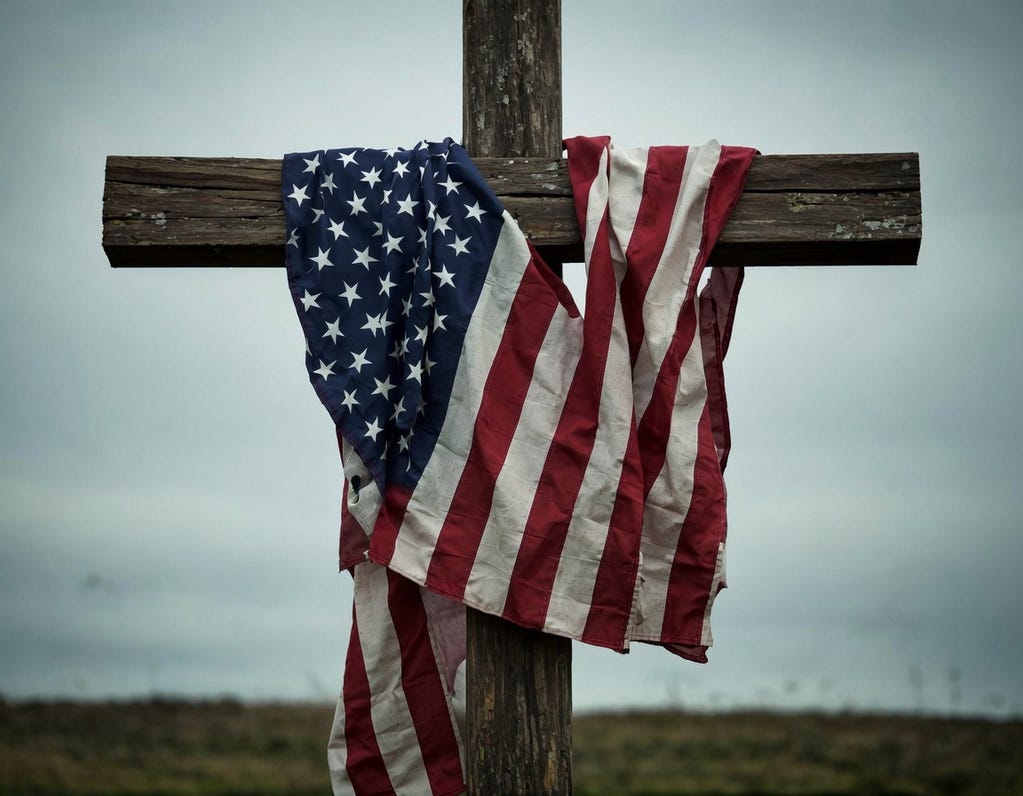
The Flag Draped Cross
Christian Nationalism as Secularism’s Completion

The standard theological response to Christian nationalism has been substantially correct and substantially insufficient. Bishops have called it heresy. Scholars have documented its distortions of scripture and history. Houses of Bishops have passed resolutions, issued reports, and signed statements. The labels are accurate. The analysis is sound. I have deployed them myself. And the movement continues to grow, apparently immune to correction, drawing millions of baptized Christians into a program that inverts the very Gospel it claims to defend.1
We need to understand why the diagnosis fails before we can reverse it. If sound theological argument cannot access the phenomenon we are diagnosing, then this failure is not merely the fault of Christian nationalism’s leaders being either stubborn or poorly educated. It is structural. Something about the cultural logic that permits Christian nationalism also renders the standard corrective impotent. Until we figure out what that something is, we will continue to make sound statements that have no effect whatsoever, and we will continue to see the distance between the sign “Christian” and the Lord who bears that name stretch beyond recognition.
This is the prior question this essay pursues. It is not what Christian nationalism is, though we will give that careful consideration in a moment. It is not even whether it is as repugnant from a theological perspective as we suspect, tough it is. The question before us is why our best theological punches are not landing, and what that failure teaches us about how faithful public theology must operate differently.
Two vignettes from America’s recent past deserve to frame this discussion side-by-side.
In the first, a man wearing a fur-trimmed horned helmet storms the United States Senate chamber, a wooden staff planted with an American flag in his hand, scripture tattooed across his chest. In the second, the astronaut Victor Glover floats inside the International Space Station’s cupola, preparing communion elements in a small plastic bag, the blue curve of the earth filling the window behind him.2
Both men claimed the Christian faith. One stormed a building in its name. The other received the Body of Christ two hundred and fifty miles above every flag ever sewn.
The distance between those two images is not, as it is so often framed, the distance between a distorted Christianity and an authentic one. It is the distance between a sign that has lost its referent and a sign still connected to the reality it bears. That distinction is the argument of this essay, and it is the argument the standard theological corrective has consistently failed to make.
I. Why the Correct Response Fails
The standard theological corrective to Christian nationalism deploys labels. It calls CN heresy, idolatry, apostasy. These labels are accurate, and I do not retract them. But labels operate on the assumption that the audience shares the grammar within which the labels carry meaning. Call something “heresy” and the word lands only if the listener already inhabits the theological tradition well enough to feel the weight of creedal departure. Call it “idolatry” and the charge registers only if the listener already knows what the worship of the God who made heaven and earth demands and forbids.
The cultural condition that produced Christian nationalism is precisely the condition in which that shared grammar has been destroyed. This is why the label response, however accurate, mirrors the structure it intends to oppose. It deploys a sign without doing the referential work that would give the sign its content. It adds another free-floating label to a culture already saturated with labels that point nowhere. It is, to use the philosopher Jean Baudrillard’s term, a simulacral response to a simulacrum.3
But there is a deeper failure, and it requires honest naming even when it is uncomfortable. When the liberal public theologian critiques Christian nationalism as bad history, misdiagnosed problems, and logical inconsistencies, they have already conceded the most important ground. They have accepted that the dispute is epistemological rather than ontological, a contest about who has the better account of social reality. This positions the theological tradition as one contestant among others in a public argument about facts and interpretations, governed by the secular rules of analytical accuracy.
This is not a neutral methodological choice. It is a capitulation. It says, implicitly, that the Gospel’s claim on this situation is its capacity to produce better social analysis than the nationalists produce. When the criterion of judgment is analytical accuracy, the theological tradition has no distinctive contribution to make. Any competent historian can expose Christian nationalism’s bad history. Any careful sociologist can dismantle its misdiagnosed problems. The theologian who does only this has made herself redundant.
Worse: the liberal theological response and Christian nationalism share the same structural problem. Christian nationalism evacuates the theological referent and deploys the Christian sign for nationalist political purposes. The liberal theological response evacuates the theological referent and deploys the Christian tradition for liberal democratic purposes. Both operate inside what Charles Taylor calls the “immanent frame,” the closed system of cultural reference within which all meaning-making proceeds without appeal to genuine transcendence.4 Both have accepted the secular framing in which religious conviction is a privately held belief that enters public discourse by generating policy preferences and cultural arguments.
This is why the liberal theological response to Christian nationalism so often feels hollow even when it is correct. The person drifting toward Christian nationalism does not experience the liberal correction as a theological challenge. They experience it as a political disagreement dressed in theological language. And they are right. That is exactly what it is.
The prior question, therefore, is this: what would a response look like that operates at the level of the referent rather than the level of the sign? What does public theology do when it refuses both the nationalist simulacrum and its liberal mirror image? That question requires understanding, first, how the referent was lost.
II. The Sign Evacuated
Baudrillard described a process by which signs pass through four stages in their relation to reality.5 In the first stage, the sign reflects a basic reality. In the second, it masks and perverts that reality. In the third, it masks the absence of the reality, the referent has been removed but the sign persists, performing as though it still points somewhere. In the fourth and final stage, the sign becomes a pure simulacrum, generating its own hyperreality with no relation to any original. It has murdered its referent and continues to walk around in its clothes.
The word “Christian” in Christian nationalism has completed this journey. It carries no creedal content. It does not mean Nicene. It does not mean baptismal. It does not mean the crucified and risen Lord of the Apostles’ Creed who suffered under Pontius Pilate. It means: white, Western, culturally conservative, politically nationalist, nostalgic for a social order predating the civil rights movement. The sign has been evacuated of every theological referent and refilled with cultural-political content.
The philosophical genealogy of this evacuation runs deeper than the current political moment, and tracing it matters because it explains why the problem is structural rather than incidental. It also explains why the liberal correction, which operates at the same structural level, cannot reach it.
The medieval theologian Duns Scotus argued that being is predicated univocally of God and creatures: the word “being” means the same thing applied to God as to any finite thing, only God’s being is infinitely greater.6 The consequence is large. When being is univocal, God becomes one being among others, ontologically continuous with the world. The creature no longer participates in the divine being as in a transcendent ground. It merely resembles it at a distance. William of Ockham completed the move: if universals are merely names we apply to collections of individuals, then words are conventional signs pointing to individual things, with no participatory relation to any transcendent reality they partially instantiate.7 Descartes sealed the thinking self inside its own interiority and made the external world pure dead extension. The cosmos became mechanism. Signs became arbitrary human conventions applied to inert matter.
What this produces, over several centuries, is what Charles Taylor calls the “buffered self” sealed from transcendent address, inhabiting an immanent frame in which all meaning-making proceeds within a closed system of reference. Inside this cultural condition, “Christian” becomes available as a pure identity marker, detached from the theological ground that once gave it meaning, available for political deployment as a pure signifier of civilizational belonging.
This is precisely what the sociologist Robert Bellah warned about in 1975. In The Broken Covenant, written on the eve of the American bicentennial, he declared that the American civil religion he had identified in 1967 had become “an empty and broken shell.”8 He had observed something genuine in his original essay: the United States possessed a shared grammar of national purpose, drawing on biblical symbols and themes, existing alongside and distinct from the churches.9 What he saw in 1975 was that grammar’s collapse into what Philip Gorski later named with precision: religious nationalism, civil religion’s dark side, emerging when the prophetic tradition of national self-criticism is replaced by conquest narratives, blood rhetoric, and apocalyptic politics.10
The people most vulnerable to Christian nationalism are those most thoroughly formed by the secular epistemic structure CN claims to oppose: people for whom “Christian” has always meant cultural identity and moral community rather than creedal confession and sacramental participation in the life, death, and resurrection of Jesus Christ. Christian nationalism offers them a more intense, politically mobilized version of the cultural Christianity they already inhabit. It requires no theological disruption because the theological content was already absent. The colonization was complete before the nationalists arrived.
Here is the irony stated in full: Christian nationalism presents itself as the defense of Christian civilization against the encroachments of secular culture. It is, in theological and philosophical fact, the completion of the secular project it claims to resist. The flag draped over the cross is not Christianity triumphant over the secular order. It is the secular order triumphant over Christianity, having successfully converted the sign of the crucified Lord into a pure cultural simulacrum serviceable for nationalist politics.
And the liberal theological critique that responds to this only at the level of political and intellectual error has accepted the secular court’s jurisdiction over a dispute that is not, at its root, about history or logic at all.
III. The Referent Restored
If we are going to give this evacuation of the referent its proper name, we need to take something back. Not as an argument. As the referent itself.
“We believe in one God, the Father, the Almighty, maker of heaven and earth, of all that is, seen and unseen.” The God who made heaven and earth does not especially belong to America. The God who specially belongs to America is not the God who made heaven and earth. The prophets called this henotheism: worship of a localized patron god. It was idolatry, the worst kind of covenant betrayal, according to Isaiah.11
“Jesus Christ, who for us and for our salvation came down from heaven… suffered under Pontius Pilate.” This is the Creed’s only mention of history, and its reasons for including it are doctrinally incendiary. Pontius Pilate was the Roman governor of a territory under military occupation. Jesus suffered at the hands of the state. Central to Christian identity, the Creed declares, is that our Lord was martyred by a thoroughly fused civil-religious order. It does not say that Jesus conquered through Pilate. It says he was killed by him.
Before Pilate, Jesus declared, “My kingdom is not from this world. If my kingdom were from this world, my followers would be fighting to keep me from being handed over.”12 Political power and the divine will do not work the same way. National self-assertion and the logic of God’s kingdom are not compatible. When tempted to set himself up by force, Jesus refused.13 When given the option of summoning heavenly forces, He chose the cross.14 This well-documented, costly refusal to exercise coercive force is the single most incontrovertible pattern in the Gospels. It is the logic that Christian nationalism turns upside down.
“Blessed are the poor in spirit... blessed are the meek... blessed are the merciful... blessed are the peacemakers.”15 “I was a stranger and you welcomed me… I was sick and you took care of me… I was in prison and you visited me.”16 The nations are judged by their treatment of precisely those persons whom Christian nationalist policy programs target for exclusion, criminalization, or expulsion. The immigrant. The uninsured poor. The incarcerated.
These are not debating points available for reinterpretation in light of current political pressures. They are the referent. They are what “Christian” points to when the sign still carries its content. Restoring them is not a political act. It is a theological one, and it is the only act adequate to the simulacral condition. You do not defeat a sign that has lost its referent by deploying a counter-sign. You defeat it by inhabiting the referent so completely, so visibly, so persistently, that the pretender is exposed by contrast.
IV. Three Architects and Their Specific Errors
The intellectual formation of the current movement’s most prominent figures requires examination because their specific errors illuminate the structural condition more precisely than a general indictment of bad faith. These are, in the main, intelligent people. Their failures are therefore more instructive than the failures of the merely ignorant.
Pete Hegseth, confirmed as Secretary of Defense in January 2025, represents the institutional-military expression of Christian nationalist ideology at the highest levels of American government.17 His theological formation connects through his Tennessee congregation to Christ Church in Moscow, Idaho, led by Pastor Doug Wilson, whose documented positions include the view that antebellum slavery was a “beneficent American institution” and that the global war on terror constitutes a modern iteration of the medieval Crusades.18 Hegseth has described Christian students as “foot soldiers” in a “spiritual battle” and Christian schools as “boot camp.” He has hosted worship services at the Pentagon led by his personal pastor during working hours and scrapped military spiritual care resources designed to serve members of all faiths. In Nashville in February 2026, before the National Religious Broadcasters, he declared a “direct through line from the Old and New Testament Christian gospels to the development of Western civilization and the United States of America,” a claim that prompted chants of “USA! USA!” and “Christ is King!” from the audience.19
The specific theological error is the confusion of baptism with citizenship and the Church’s mission with the state’s coercive apparatus. Hegseth has not misread the Gospel. He has evacuated it and replaced it with a program of civilizational dominance for which the Christian vocabulary serves as a legitimating sign that has lost its referent. The “Christ is King” chant does no theological work. It performs a cultural-political identity. It is the simulacrum in its purest available form.
Vice President JD Vance presents a more intellectually sophisticated case. A convert to Roman Catholicism, he moves in the networks of Catholic post-liberalism and integralism associated with Patrick Deneen at Notre Dame and Harvard Law professor Adrian Vermeule.20 His intellectual formation was shaped significantly by the tech investor Peter Thiel, who introduced him to the French philosopher Rene Girard.
In 2020, Vance wrote with apparent theological precision about what he had learned from Girard’s mimetic theory:
In Christ, we see our efforts to shift blame and our own inadequacies onto a victim for what they are: a moral failing, projected violently upon someone else.
21 This is a correct reading of Girard’s central argument. It is also a self-indicting one in light of what followed.
In September 2024, Vance spread across social media the claim that Haitian immigrants in Springfield, Ohio, had been abducting and eating residents’ pets.22 Springfield city officials immediately stated that no credible reports of any such activity existed. A Vance aide was informed directly by the Springfield city manager that the claims were false. Vance continued spreading them.23 When pressed on CNN, Vance offered a confession of extraordinary theological gravity: “If I have to create stories so that the American media actually pays attention to the suffering of the American people, then that’s what I’m going to do.”24
He admitted he fabricated the scapegoat narrative. The man who in 2020 named scapegoating as a moral failing admitted on national television four years later that he had constructed one deliberately, knowing the victims were innocent. The bomb threats that followed against Springfield schools and community centers are the measurable human cost of the mechanism Vance had named, understood, and then operated.
This is not a failure of theological understanding. It is the possession of the diagnostic and the deliberate refusal of the prescription. Girard’s life work was animated by the conviction that the Gospel’s unmasking of sacred violence constitutes a summons to stand with victims rather than construct better scapegoats. Vance received the theory as a strategic resource. This is a different and more serious failure than ignorance. It is the conscious choice to operate the mechanism the cross refuses.
Peter Thiel’s case is the most philosophically complex. He studied under Girard at Stanford and has described himself as a “hardcore, unreconstructed Girardian.”25 He has simultaneously drawn on Carl Schmitt, the Nazi jurist whose central claim is that politics is defined entirely by the friend-enemy distinction and that the sovereign is the one who decides on the state of exception.26
Girard and Schmitt are not complementary thinkers. They are antithetical ones. Girard diagnoses the friend-enemy distinction as the scapegoating mechanism in its political form and calls Christians to renounce it. Schmitt celebrates this structure as the irreducible grammar of all political life. Wolfgang Palaver, the Austrian theologian who has spent four decades applying Girard’s thought as a critique of Schmitt, has named the contradiction with precision: “Ultimately, Thiel needs to choose who he is going to imitate. In the end, you have to decide: Are you really going to be a Christian in a proper sense? Or are you a Schmittian?”27
Thiel’s career answers the question. The Girardian vocabulary remains in his speeches as sophisticated patina over a political program that constructs the immigrant, the regulator, and the globalist as enemies against whom nationalist solidarity must be mobilized. The scapegoating mechanism, dressed in the vocabulary of the scholar who most clearly identified and condemned it. This is the intellectual form of the simulacral operation: the sign of genuine theological insight, evacuated of its prescriptive content, redeployed as analytical cover for the practice it diagnoses.
What unites all three figures is not theological error in the classical sense. It is the structural condition the essay has named: the reception of the Gospel’s vocabulary as a resource for a program of civilizational power, detached from the referent that gives that vocabulary its meaning and its demand. Hegseth performs it institutionally. Vance performs it strategically. Thiel performs it philosophically. The operation is the same in each case. The sign walks in its referent’s clothes.
V. The Response Adequate to the Condition
If the problem is not primarily epistemological but ontological, the response adequate to it is not a better argument but a restored practice. This demands specificity, because “formation” and “community” can themselves become simulacra, signs that gesture toward a practice without enacting it.
The philosopher Alasdair MacIntyre, diagnosing the collapse of moral argument in modernity, argued that the problem was not the inadequacy of the arguments but the loss of the shared grammar that would make the arguments resolvable.28 His prescription was the formation of local communities of practice in which the grammar is kept alive. Ludwig Wittgenstein’s distinction between saying and showing is the philosophical ground for this: the deepest things are apprehended through participation rather than demonstrated through inference.29
Applied to the present situation: the grammar of the Gospel, the grammar within which “heresy,” “idolatry,” and “apostasy” carry their proper weight, is not derived from first principles accessible to unaided reason. It is inhabited. It is practiced into being. It is the form of life within which the a priori God becomes recognizable as precisely that.
If God is not the conclusion of an argument but the prior ground of all arguments, the one in whom, to quote Paul to the Athenians, we live and move and have our being30 then the apologetic task is not to construct an argument that builds a road from the skeptic’s starting point to the theological conclusion. The road is already built. The task is formation into the form of life within which what is always already given can become recognizable. You cannot argue someone into the grammar they have never inhabited. You can only invite them into the community where the grammar is practiced.
Katherine Sonderegger, the Episcopal systematic theologian whose doctrine of God may prove to be the single most important Anglican contribution to this question in a generation, names this on the doctrinal side divine compatibilism: God and creatures do not compete over space occupied.31 God is completely present without displacing the reality of creatures, as fire that warms without consuming, light that illumines without destroying. The secular and the sacred do not occupy the same space in competition. The God who is a priori is already present within the creature’s ordinary reasoning, within the scientist’s laboratory, within the child’s first question, without any of these having to first be defeated or thrown off the field. What is needed is formation into the way of life that perceives what is always already there.
This also means that the way the community lives is the primary public theological act, and it means that in a philosophically rigorous sense as well as a pastoral one. The community gathered at the table, practicing the grammar of the Kingdom across every boundary that the nationalist program seeks to draw between insider and outsider, is doing publicly what argument cannot: restoring the sign to its referent by making the community itself live the referent. The Eucharist does not represent or signify the body of Christ. It participates in that reality. It eats the real. It is the counter-simulacrum, the tangible violation of the hyperreal.
Bishop Rob Wright gave a sermon to the Episcopal House of Bishops in March of 2025 on the anniversary of the crossing of Selma bridge entitled “dangerous oddness,” the form of Christian witness that exposes how things “ought not to be” by letting ourselves be disturbed by how things actually are.32 He is correct. The word “odd” finds its philosophical grounding in this essay. The church’s dangerous oddness is the counter-simulacrum, the baptismal embodying of the truth that the sign “Christian” still signifies something, that the pointing still refers to something beyond itself.
VI. What This Demands of the Bishop
By way of conclusion, let me be clear about what this means for bishops, because the precise nature of episcopal leadership bears heavily on how any of this is able to be lived in particular contexts.
The primary public theological act of a bishop is the formation of communities whose common life reconnects the sign “Christian” to its referent by making the children of God dwell together as those whom God has blessed. This will mean preaching that forms Christians according to the Beatitudes and not according to grievance. Worship that builds genuine catholic community across the manifold political and cultural fault lines the nationalist project seeks to use to divide people. Pastoral presence that is visibly and intentionally centered on the poor and the powerless, the stranger, the prisoner, and the sick not as a political statement but as the life of the Kingdom enacted. It will mean the bishop’s calendar being shaped by Matthew 25, not the theater calendar of the affluent.
It will mean refusing to engage in label wars without refusing to prophesy. If the bishop calls Christian nationalism idolatrous then she must do so in such a way that simultaneously enacts what it looks like to worship the true God. The word “idolatry” earns its keep by pointing to something only when it is accompanied by the living demonstration of what true worship of the God who made heaven and earth looks like: the welcoming of the stranger into your parish community, the feeding of the hungry at your table, the refusal of every national god that comes wrapped in Christian language. The label without the life is just another simulacrum.
It will mean refusing to allow oneself to become the political project of either major party by maintaining what William Temple called the Church’s prophetic distance, the knowledge that every political program can and should be criticized from the perspective of the Gospel regardless of who holds political power at the time.33 The bishop who conducts business as usual with Democrats but thinks that Christians should boycott Republicans has already lost because she has owned herself rhetorically to one political party. The Christian who feels free to issue public statements against Christian nationalism from the left without holding the progressive capture of the Church’s public vocabulary to the same Gospel-centered standard has not departed from the simulacral prison. They have just replicated it at another ZIP code.
That is my counterproposal to Christian nationalism. Is it sufficient? Does it form up folks differently than grievance does? These are questions worth discussing, but whatever discussions follow must take seriously the thesis of this essay: Settling for labels repeats the same mode of operating that produced Christian nationalism in the first place. If you agree with that, then please take special care that every label you deploy in this conversation earns its referential keep.
Notes
1. For representative examples of the episcopal and theological response, see The Episcopal Church House of Bishops Theology Committee, The Crisis of Christian Nationalism (New York: Church Publishing, 2023); William J. Barber II, interview, CNN, 2023; Rob Wright, “Christian Nationalism and Christian Witness,” address to the Episcopal House of Bishops, Nauvoo, Alabama, March 21, 2025.
2. The January 6, 2021 assault on the United States Capitol is extensively documented in the bipartisan Select Committee report, Final Report of the Select Committee to Investigate the January 6th Attack on the United States Capitol (Washington: Government Publishing Office, 2022). On Glover’s communion, see Michael Foust, “NASA Astronaut Victor Glover Took Communion in Space,” Christian Headlines, April 28, 2021.
3. Jean Baudrillard, Simulacra and Simulation, trans. Sheila Faria Glaser (Ann Arbor: University of Michigan Press, 1994), 1-42. The four stages of the image are described in the opening chapter, “The Precession of Simulacra.” For the application of Baudrillard’s analysis to religious sign-systems in consumer culture, see Vincent J. Miller, Consuming Religion: Christian Faith and Practice in a Consumer Culture (New York: Continuum, 2004), 67-105.
4. Charles Taylor, A Secular Age (Cambridge: Harvard University Press, 2007), 539-93. Taylor’s analysis of the “immanent frame” and the “buffered self” is the most sustained account of the cultural epistemic condition this essay addresses. For the theological application, see James K. A. Smith, How (Not) to Be Secular: Reading Charles Taylor (Grand Rapids: Eerdmans, 2014).
5. Baudrillard, Simulacra and Simulation, 6.
6. For Scotus’s univocity of being and its theological consequences, see John Milbank, Theology and Social Theory: Beyond Secular Reason, 2nd ed. (Oxford: Blackwell, 2006), 302-5; and the extended treatment in Louis Dupre, Passage to Modernity: An Essay in the Hermeneutics of Nature and Culture (New Haven: Yale University Press, 1993), 37-60.
7. On Ockham’s nominalism and its consequences for the sign-world relation, see Catherine Pickstock, After Writing: On the Liturgical Consummation of Philosophy (Oxford: Blackwell, 1998), 121-66; and Dupre, Passage to Modernity, 56-88.
8. Robert N. Bellah, The Broken Covenant: American Civil Religion in Time of Trial, 2nd ed. (Chicago: University of Chicago Press, 1992), xi.
9. Robert N. Bellah, “Civil Religion in America,” Daedalus 96, no. 1 (Winter 1967): 1-21.
10. Philip S. Gorski, American Covenant: A History of Civil Religion from the Puritans to the Present (Princeton: Princeton University Press, 2017), 5, 35. Gorski’s formulation is precise: “Religious nationalism is the dark side of civil religion.” His distinction between the prophetic-egalitarian tradition and the nationalist-providentialist tradition is the most useful historical taxonomy for understanding the current moment.
11. Isaiah 44:6; 45:5-6. For the prophetic critique of henotheism as the primary form of covenant infidelity, see Walter Brueggemann, Theology of the Old Testament: Testimony, Dispute, Advocacy (Minneapolis: Fortress, 1997), 145-72.
12. John 18:36 (NRSV).
13. John 6:15.
14. Matthew 26:53.
15. Matthew 5:3-9 (NRSV).
16. Matthew 25:35-36 (NRSV).
17. On Hegseth’s confirmation margin, see the coverage in The New York Times, January 25, 2025. Vice President Vance cast the tie-breaking vote in a 51-50 confirmation.
18. Heath Druzin, “Trump’s Defense Secretary Nominee Has Close Ties to Idaho Christian Nationalists,” NBC News, November 25, 2024. On Wilson’s documented positions regarding slavery and the Crusades, see Logan Davis, “Christian Nationalist at the Pentagon: Pete Hegseth’s Calvinist Sect Embraces Confederacy, Crusades,” Democracy Now!, January 27, 2025.
19. Sam Stockard, “In Nashville, Hegseth Talks ‘Western Values,’ Christian Nationalism,” Tennessee Lookout, February 21, 2026.
20. For Vance’s intellectual connections to Catholic post-liberalism and integralism, see the extended treatment in Slate, “JD Vance’s Religion: How Catholicism Changed the Candidate’s Worldview,” August 8, 2024; and National Catholic Register, “JD Vance Is a Catholic ‘Post-Liberal,’” July 29, 2024. For the internal Catholic critique of integralism, see Dignitatis Humanae (Vatican II, 1965); and “Evangelical Fundamentalism and Catholic Integralism in the USA,” La Civiltà Cattolica, July 2017.
21. JD Vance, “How I Joined the Resistance,” The Lamp, 2020. The direct quotation is confirmed in multiple subsequent reports, including the Globe and Mail’s analysis of the Thiel-Vance-Girard intellectual lineage, 2024.
22. CBS News, “Officials in Springfield, Ohio, Say No Credible Reports of Haitian Immigrants Abducting and Eating Pets,” September 9, 2024; NPR, “JD Vance Repeats Baseless Claims About Haitian Migrants and Pets,” September 10, 2024.
23. ABC News, “Vance Kept Up False Claims About Haitian Migrants After Aide Was Told They Were Baseless,” September 18, 2024, reporting on the Wall Street Journal’s documentation of the September 9 call between Springfield city manager Bryan Heck and a Vance staffer.
24. CNN, “State of the Union,” Dana Bash interview with JD Vance, September 15, 2024. Direct quotation from the broadcast transcript.
25. Thiel’s self-description as a “hardcore, unreconstructed Girardian” is widely documented. For extended analysis, see “The Real Stakes, and Real Story, of Peter Thiel’s Antichrist Obsession,” Wired, October 2025.
26. Carl Schmitt, The Concept of the Political, trans. George Schwab (Chicago: University of Chicago Press, 1996). For the theological analysis of the Schmitt-Girard tension, see Wolfgang Palaver, Rene Girard’s Mimetic Theory, trans. Gabriel Borrud (East Lansing: Michigan State University Press, 2013), 239-72.
27. Wolfgang Palaver, quoted in “The Holy Hypocrisy of Peter Thiel’s Armageddon,” Gazetteer SF, October 6, 2025, reporting on remarks to Wired. The full interview context is documented in the Wired piece of October 2025.
28. Alasdair MacIntyre, After Virtue: A Study in Moral Theory, 3rd ed. (Notre Dame: University of Notre Dame Press, 2007), 1-5, 263-64.
29. Ludwig Wittgenstein, Philosophical Investigations, trans. G.E.M. Anscombe, P.M.S. Hacker, and Joachim Schulte (Oxford: Wiley-Blackwell, 2009), sec. 201. For the theological application of the showing-saying distinction, see Denys Turner, Faith, Reason and the Existence of God (Cambridge: Cambridge University Press, 2004), 35-72.
30. Acts 17:28 (NRSV).
31. Katherine Sonderegger, Systematic Theology, Volume 1: The Doctrine of God (Minneapolis: Fortress Press, 2015), 49-149. The burning bush as the paradigm of divine compatibilism is the organizing image of Sonderegger’s treatment of omnipresence. Sonderegger is the William Meade Professor of Theology at Virginia Theological Seminary and an Episcopal priest.
32. Rob Wright, “Christian Nationalism and Christian Witness,” address to the Episcopal House of Bishops, Nauvoo, Alabama, March 21, 2025. Published by the Episcopal Diocese of Atlanta, March 27, 2025.
33. William Temple, Christianity and Social Order (London: Penguin, 1942), 29-43. Temple’s distinction between announcing principles and administering programs remains the most precise Anglican formulation of the Church’s proper relation to the political order.
34. Tertullian, Apologeticus, 39.7. For the apologetic significance of the community’s common life in the early church, see Alan Kreider, The Patient Ferment of the Early Church: The Improbable Rise of Christianity in the Roman Empire (Grand Rapids: Baker Academic, 2016).
35. Revelation 5:9 (NRSV).