
No Ghost in the Machine
5 in the AI Series: The Body Is Not the Tomb but the Temple of the Soul

Excerpts from Unabashed Faith (2025)
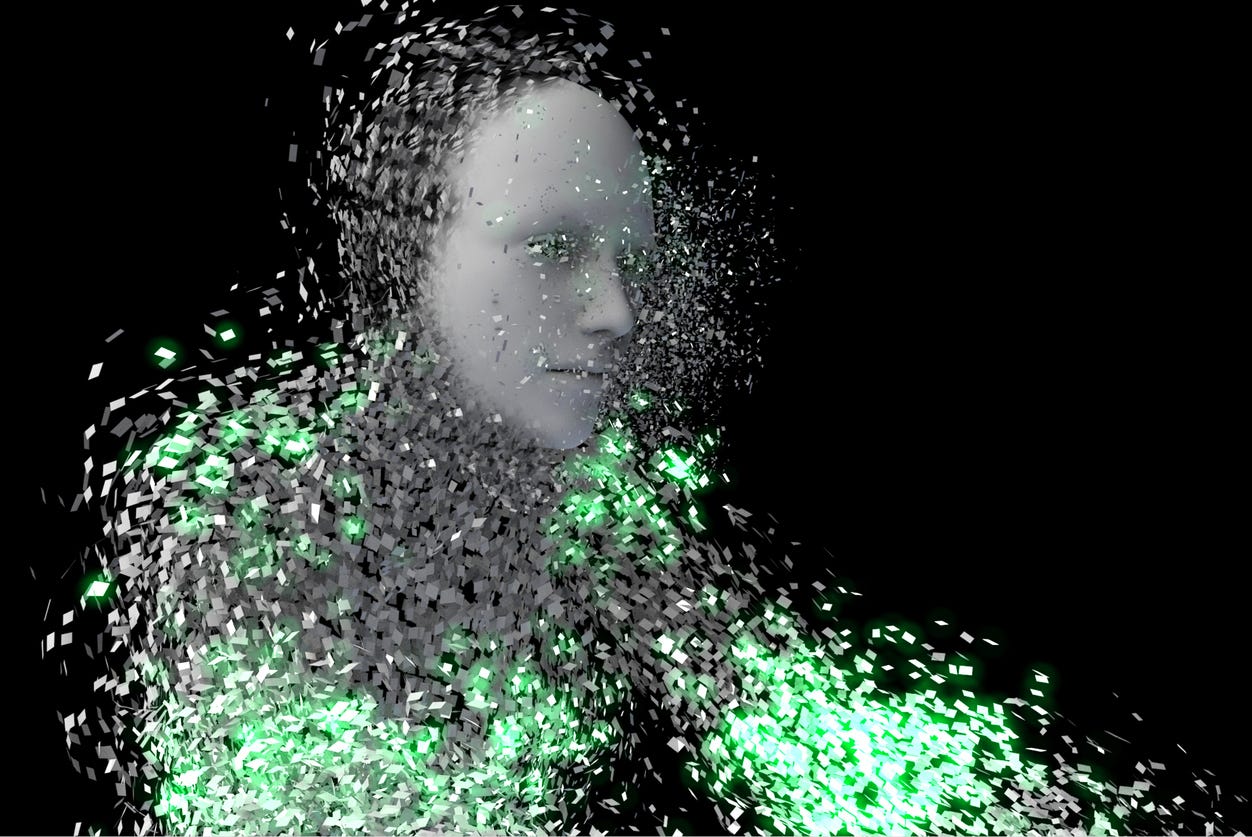
The body is not the tomb but the temple of the soul. It is in the flesh that we live. It is in the flesh that we love.
I. The Ghost in the Machine
The phrase “ghost in the machine” first appears in the work of the Oxford philosopher Gilbert Ryle in his 1949 book The Concept of Mind. It was a deliberate insult. Ryle used the phrase to attack René Descartes’s theory of mind/body dualism. Cartesian dualism, as it is known, is the view that the mind and the body are two fundamentally different things and can be separated. The body, in this view, is corporeal, and it operates in the physical world. The mind (or soul, as is commonly meant by the use of the term), by contrast, is not of the body, and it exists independent of the body in an entirely separate realm, having some supernatural capacity to interact with the body.
Ryle maintained that this dualistic idea was fundamentally a mistake of categories, a basic logical error, because it treats the mind as a non-physical entity that somehow “lives inside” and directs the physical body, like a “ghost” that “haunts” a “machine.” He thought that this was illogical because it depended on the assumption that mental states (like thinking or feeling pain) were utterly unlike physical states (like moving or touching) rather than alternative modes describing the same things (Ryle, 1949).
Arthur Koestler then appropriated the phrase as the title of his book on philosophical psychology that today has a cult following: The Ghost in the Machine (1967). In it, Koestler engaged in vehement criticism of reductionist methodologies in philosophy, behaviorism, and other mechanicalistic approaches that seek to explain human experience and behavior within the context of machine processes. Think of it this way: he is against the theories proposed that people and animals learn and behave through their interactions with the environment and other creatures and, therefore, can be traced. This and similar theories assert that all behavior is learned through conditioning, which is a process of reward and punishment. Koestler’s ghost in machine dichotomy promoted an intuitive approach to human experience, associating the specialness of the body’s experience with spiritual and even transcendental properties. This is a kind of in-between theory that suggests there is always more going on than simply what is observed, and thus, we are creatures, not machines.
By coining the phrase “ghost in the machine,” both Ryle and Koestler sought to draw our attention to the limitations of thinking about the human mind–body composite in purely dualistic and mechanistic terms. Ryle’s attack targeted the illogical nature of Cartesian dualism, while Arthur Koestler extended this critique to examine the fuller implications of paring back human experience to mere mechanics. The mind was not a machine, he argued (Koestler, 1967).
II. Spirits in the Material World
The musical artist Sting was reading a lot of Koestler in the 1980s. From his thinking about the theories presented in Arthur Koestler’s books came the 1981 Police album entitled Ghost in the Machine, The album opens with “Spirits in the Material World.” Then it continues with three songs amplifying the theme: “Too Much Information,” “Rehumanize Yourself,” and “One World (Not Three).” Ghost in the Machine then became an album that moved the ideas into popular music and framed the concerns of Koestler in musical terms. Sting, reflecting on the album and songs, talked about how a dualist approach was fodder for totalitarianism. He believed at the time that Koestler was holding up a mirror to the lives of the Northern Irish and other human conflicts around the world. Reflecting on his experience, Sting said in an interview:
The reason we have to attack behaviorism is because it’s been used by totalitarian regimes as an easy way of making people conform. A robot fits into big ideas much better. Whereas a thinking human being, a complex spiritual being, which is what we are, is out of place. You only have to look at the kids on the streets; they’re becoming dehumanized (Sting, 1981).
Shortly after the album was released, there appeared a wholly separate yet interesting manga and anime series called Ghost in the Shell (1989–1990; 1995–1997). It depicted a near future in which humans start integrating themselves with machines. The stories take place in 2029 and follow a counterterrorism agency as they try to track down a cyber-criminal named the Puppeteer. This villain is a master of “ghost hacking.” He performs crimes using the bodies of humans fitted with so-called cyberbrains. Spoiler: It turns out that the Puppeteer is an artificial intelligence who has taken up residence in a robot body. Masamune Shirow wrote the manga series. Production I.G. made an anime feature written and directed by Kenji Kamiyama. It aired from 2002 to 2005.
The anime film Ghost in the Shell (1995) is widely seen as an inspiration for the Matrix film series, which in turn borrowed specific elements, such as the dripping digital rain that the characters see, and the technique used to see inside the Matrix. Later, producer and director James Cameron cited Ghost in the Shell as one of his inspirations for Avatar (2009).
III. The Hard Problem
We have been examining a string of artistic conversations about the “ghost” and the “body.” Each of these productions takes a slightly different angle of the story of mind–body dualism. The philosophical discussion has continued. In a book on consciousness entitled The Character of Consciousness, the philosopher David J. Chalmers coined the term “hard problem of consciousness” to refer to the problem of why and how mental phenomena or consciousness arise from physical activity in the brain. He calls this the “mind out there” (Chalmers, 2014).
In short, the “hard problem” is this: we know that the brain is made of neurons and that neurons send and receive information to and from each other in the form of electrical and chemical signals; but a thought, a condition of mind or feeling, or a mental picture of a sunset are something(s) of which we subjectively, as an individual, are aware of having an experience of—that is what people usually mean by “conscious.” I am paraphrasing from my reading of Chalmers (Chalmers, 2014). We know so much more today than ever before about how the brain works. We are close to knowing and understanding exactly how the neurons fire and are associated with behavior. However, what we do not know is why we have something called subjective experience. Chalmers is curious if we will ever know.
As one reads Chalmer’s work, one begins to feel that perhaps there is, in fact, a type of ghost in the machine (at least in his theory). He is quick to add, though, that the mind is not something disconnected from the brain, but something extra created by it. Consciousness is not reduceable, Chalmers would argue, to a mere physical reality, but it is connected to it. Chalmers concludes, in almost all essays, with the notion that the question of how all this works is an intractable problem. Maybe it is even the most intractable in philosophy and cognitive science. I agree with Chalmers but want to be clear: I do not think consciousness can be separated from the body. It may surprise you to read that ancient theology holds tightly to this body, brain, and consciousness/spirit as one thing. This is such an essential concept in this book that it deserves a chapter of its own.
IV. From Consciousness to Reason
Jonathan Haidt is a social psychologist. His work explains why science does not support such dualism. As I read his work, I became familiar with his thoughts on the body and reason. He is a researcher who can help us understand why we cannot jettison the body (Haidt, 2012). Haidt draws on various disciplines, including psychology, neuroscience, evolutionary biology, and anthropology, to argue that the mind is not separate from the body and instead is deeply interconnected with it. This means that consciousness and the notion of reason are a product of both brain and body.
Evolutionary psychology explains that human moral reasoning and emotions have developed over time to enhance survival and social cooperation. Haidt emphasizes the role of moral intuitions (automatic, visceral responses that guide moral judgment) arguing that these intuitions are deeply rooted in our evolutionary past and shaped by the body’s sensory experiences.
Haidt frequently references neuroscience research to support this claim. The work of neuroscientist Antonio Damasio illustrates that emotions are fundamental to rational decisionmaking and moral reasoning. He suggests that bodily sensations play a connective role in decisionmaking by helping individuals evaluate options based on past emotional experiences (Damasio, 2008).
Haidt discusses the dual-process theory of cognition, distinguishing between two types of cognitive processes: intuitive (fast, automatic, and often emotionally driven) and reasoning (slow, deliberate, and logical). He argues that much of our moral thinking is dominated by intuitive processes rather than rational deliberation, reflecting a more embodied form of cognition. This agrees with the work of Nobel Prize winner Daniel Kahneman in his book Thinking Fast and Slow (Kahneman, 2011).
Haidt draws from the field of embodied cognition, which argues that cognitive processes are deeply rooted in the body’s interactions with the world. He suggests that emotions and moral intuitions are not just “in the head” but are also experienced throughout the body, influenced by physical states and sensations. He incorporates anthropological findings that highlight the cultural and social-dimensional beginnings of morality, showing how different societies use rituals, bodily practices, and social norms to cultivate moral behaviors. For example, he discusses how practices like communal worship or shared meals foster a sense of belonging and moral cohesion, which he sees as grounded in bodily experiences and social emotions.
Haidt’s work synthesizes various scientific resources to argue for an integrated view of the mind and body. He maintains that moral intuitions, emotions, and reasoning are not separate entities but rather are deeply interwoven with our bodily experiences and evolutionary heritage. This perspective challenges the Cartesian dualism that separates mind and body, emphasizing a holistic understanding of human psychology (Haidt, 2006, 2012).
V. The Body
We humans are language animals, and we are amazing creatures. We can think and reason and deliberate and discern. We can open ourselves up to creation and other people. We are curious. I find the work of theologians Charles Taylor, Rowan Williams, and David Bentley Hart on language interesting, and we shall touch on their work in later chapters. I also find Chalmers’s theory of consciousness and its hard problem compelling. I also believe that there is something about our whole bodies that contributes to consciousness. For me, the body itself is necessary for consciousness.
The embodied cognition theory is an idea in psychology and cognitive science that challenges the traditional view that thinking and reasoning happen only in the brain or that this work can be separate from the body. Instead, this theory suggests that our thoughts, emotions, and decisions are deeply connected to our physical experiences in the world. It means that our body—including our senses, movements, and even our physical state—plays a crucial role in shaping our thoughts and feelings. This leads me to write about embodied prayer, thought, and action. My writing in this book will explore how our embodied experience leads to our embodied moral actions; how our emotional bodies play a role in our approach to the world and others; and how our physically embodied prayer changes our approach to other people; and, finally, how our language, and the spaces between the words, are authentic spaces that are felt by an awareness of the body.
VI. Disembodiment and the New Spiritualism
Austrian theologian and priest Ivan Illich offers a corrective idea: what he calls “conviviality,” a friendliness that resumes human beings’ free and creative relationships between themselves and their surroundings (Illich, 1975). He sees life becoming subject to a radical monopoly in which digital mediation increasingly replaces all other modes of relating, including religious life. This digital mediation replaces embodied relationships in flesh and blood. The derivatization, as he calls it, or disembodiment of the human person, is starkly honest about where we are today.
In an age of disconnection and disembodiment, we see a rise in theologies that remove the spirit from embodiment and seek to separate consciousness from the body itself. We also see a rise in what might be called a new spiritualism. The continuing possibility of disembodiment through technology and spiritualism is a mixture that will have some influential voices in the coming future, yet I am offering something different in this book.
VII. The Image Returns Transformed
Here is the core of an unabashed faith: Jesus’s body was the same as ours, and our body then is the same as Jesus’s. This truth unites us individually and corporately, and nothing can separate us from this fact of created union. Moreover, by sharing this unabashed faith, we denounce the possibility that there is only good or bad, body or spirit, God separate from humanity and creation. In this faith, we recognize that technology, no matter how it seems, is only made up of manipulated matter from natural resources and thus does not have flesh and so cannot be inhabited by spirit. An unabashed faith rejects that there can be a ghost in the machine and that robots dream of sheep (see Philip K. Dick’s, Do Androids Dream of Electric Sheep?). For Christians, our theology supports the idea that God’s spirit is present in aliens more than it might support the idea that God’s spirit will be found in our robot friends.
Dualism locates spirit and body on mutually exclusive planes of good and evil. God’s whole narrative heralds another option: what is material and what is spirit are not radically opposed but rather intrinsically related. The body is not the tomb but the temple of the soul. It is in the flesh that we live. It is in the flesh that we love. We can only understand Christ’s body through our bodies. We partake of the divine not through denying the world but by accepting every body and creation. Furthermore, in knowing ourselves to be human bodies, we become more Christlike. In seeking to be more Christlike, we become more bodily human.

References
Chalmers, D. J. (2014). The character of consciousness. Oxford University Press.
Damasio, A. (2008). Descartes’ error: Emotion, reason and the human brain. Vintage Digital.
Dick, P. K. (1968). Do androids dream of electric sheep? Doubleday.
Haidt, J. (2006). The happiness hypothesis: Finding modern truth in ancient wisdom. Basic Books.
Haidt, J. (2012). The righteous mind: Why good people are divided by politics and religion. Gildan Media, LLC.
Illich, I. (1975). Conviviality: Lecture, International Institute for Labour Studies. International Institute for Labour Studies.
Kahneman, D. (2011). Thinking, fast and slow. Farrar, Straus and Giroux.
Koestler, A. (1967). The ghost in the machine. Hutchinson.
Ryle, G. (1949). The Concept of Mind. University of Chicago Press.
Sting. (1981, October 2). Sting: Discography: Ghost in the Machine. Sting.com. https://www.sting.com/discography/album/32/The%20Police.